Shifting from traditional aerosols to Bag-on-Valve (BOV) technology demands precise equipment selection. Selecting the wrong equipment leads to severe production bottlenecks. You might suffer excessive changeover downtime and compromised product integrity. This guide serves a critical purpose. We provide production managers and procurement teams an objective framework. You need specification-driven criteria to evaluate your options. We help you shortlist a bag-on-valve filling machine based on actual facility needs. You can ignore vendor hype entirely. We will teach you how to match automation to throughput accurately. You will learn to define viscosity and fill range specifications. We also cover compliance mandates for pharmaceutical, cosmetic, and food applications.
Key Takeaways
Match Automation to Throughput: Align machine selection with required Cans Per Hour (CPH) and projected scaling limits to optimize OEE (Overall Equipment Effectiveness).
Define Viscosity and Fill Range Specs: Verify that the pressure and dosing cylinders can handle your specific product characteristics without aeration or valve clogging.
Prioritize Compliance and Materials: For pharmaceutical and food applications, non-negotiable features include 316L stainless steel contact parts and Clean-in-Place (CIP) readiness.
Aligning Automation Levels with Production Output Goals
Defining Success Criteria
Moving beyond "faster is better" is essential. You must match throughput to your upstream formulation. Downstream packaging capacities also matter greatly. A fast filler serves no purpose if your cartoner lags. You need balanced line integration. We often see facilities buy high-speed systems improperly. They later struggle because mixing tanks cannot supply enough bulk product. You must define success metrics early. Evaluate your entire production floor comprehensively.
Consider these critical steps when defining your success criteria:
Audit your upstream processing output rates per shift.
Measure downstream capacity for capping, labeling, and boxing.
Calculate actual operational shift times minus planned maintenance.
Determine acceptable scrap and reject rates for your line.
Semi-Automatic BOV Machines (R&D and Low-Volume)
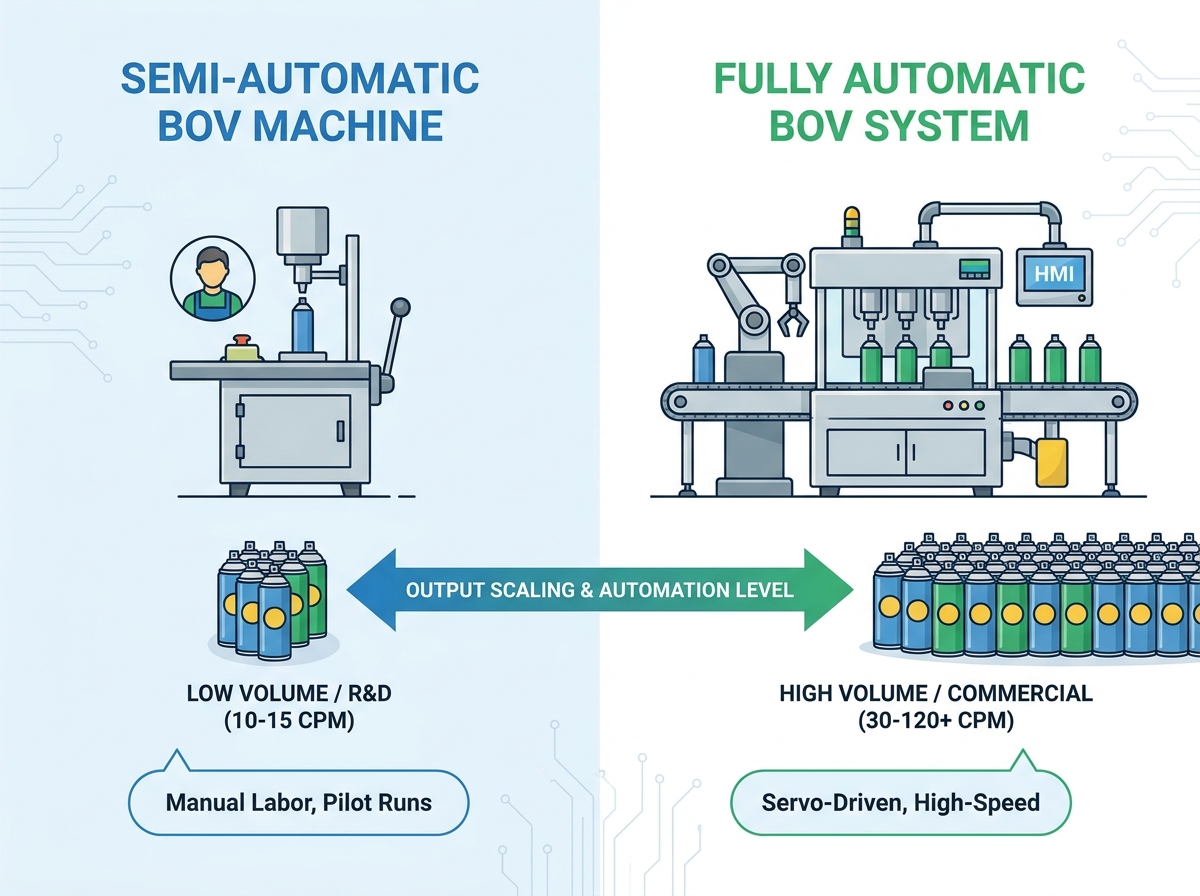
Typical output ranges between 10 and 15 Cans Per Minute (CPM). These units are best for pilot runs and clinical trials. They also suit facilities managing frequent, small-batch product variations. Startups frequently deploy semi-automatic systems. They provide excellent entry points into BOV technology.
Limitations exist regarding these setups. They rely heavily on operator pacing. The entire process remains labor-intensive. Operators manually transfer cans between crimping, gas filling, and liquid filling stations. You must watch out for human error. Inconsistent manual handling affects overall cycle times. Fatigue naturally slows down production toward the end of a shift.
Fully Automatic Rotary and Linear Systems (High-Volume)
Typical output spans 30 to over 120 CPM. This variance depends on available index stations. The number of multiple liquid filling heads also dictates speed. These machines work best for dedicated product lines. High-speed commercial production thrives on automation.
Use a specific evaluation lens here. Look for servo-driven indexing and automatic can feeding. Integrated weight checking minimizes reject rates. Fully automatic systems maintain precise control continuously. They reduce operator intervention significantly. This reduction ensures consistent OEE during long shifts. Servo motors provide smooth acceleration. This prevents liquid spillage before the valve insertion stage.
Sizing Your Bag-on-Valve Filling Machine: Fill Range and Viscosity Requirements
Dosing Accuracy and Fill Volume Limitations
Evaluate the volumetric cylinder capacity carefully. Common ranges span from 50ml to 500ml formats. You must check the tolerance margins for under and over-filling. Precision prevents costly product giveaways. It also prevents regulatory fines for under-filled containers.
High-pressure liquid filling capabilities are crucial. BOV technology forces product through the valve stem. It works against internal bag resistance and outer gas pressure. Insufficient filling pressure causes incomplete fills. Your machine must overpower the compressed air or nitrogen inside the can. Accurate dosing cylinders guarantee the exact volume enters the bag. They prevent the bag from rupturing under extreme force.
Handling Product Viscosity
Different fluids demand different handling mechanisms. You cannot use a universal approach for all liquids.
Low Viscosity (Saline, Toners): Focus heavily on anti-drip nozzles. Splash prevention is critical here. Water-like liquids can easily splash and contaminate the can exterior. This contamination ruins label adhesion later.
High Viscosity (Lotions, Gels, Creams): These require specialized positive displacement pumps. Heated hoppers help maintain consistent flow. They prevent cavitation inside the dosing cylinder. Thick products resist flow naturally. You need robust mechanical force to push them into the bag.
Liquid Viscosity Profiles and Recommended Technologies
Viscosity Level
Typical Products
Recommended Mechanism
Key Production Consideration
Low
Saline, Toners, Water
Gravity or light piston
Anti-drip nozzles to prevent splashing
Medium
Cooking oils, Syrups
Standard piston pumps
Temperature control to maintain flow
High
Gels, Lotions, Creams
Positive displacement
Heated hoppers to prevent cavitation
Industry Applications and Compliance Mandates
Pharmaceuticals & Medical Devices (Saline, Nasal Sprays, Burn Gels)
Medical products carry strict regulatory burdens. Must-have requirements include FDA and cGMP compliance. You need comprehensive validation documentation. This means securing IQ, OQ, and PQ protocols from the manufacturer. Cleanroom compatibility is absolutely mandatory for sterile environments.
Comprehensive data logging ensures 21 CFR Part 11 compliance. A proper system tracks every single parameter continuously. It logs pressure, fill volume, and operator actions. If a batch fails, you must trace the exact cause. Electronic records provide this critical traceability. Audit trails protect your facility during regulatory inspections.
Cosmetics & Personal Care (Sunscreen, Shaving Gel)
Personal care markets demand ultimate flexibility. Consumer trends shift rapidly. Must-have requirements include rapid format changeovers. You must handle multiple can sizes efficiently. Seasonal products require quick tooling adjustments.
Aesthetics-focused crimping prevents actuator damage. Scratched cans ruin brand perception immediately. The crimping head must secure the valve without marring the finish. Micro-leaks occur if the crimping depth varies. High-quality cosmetic machines use precision collets. They expand outward evenly to seal the valve securely.
Food & Beverage (Cooking Oils, Flavor Sprays)
Food safety standards dictate strict machine design. You cannot compromise on sanitation. Must-have requirements include sanitary welds across all contact surfaces. You need FDA-approved elastomers for all O-rings and seals.
CIP and SIP (Sterilize-in-Place) integration prevents cross-contamination. Stagnant zones harbor dangerous bacteria. Your machine must drain completely during cleaning cycles. Quick-release clamps allow operators to inspect fluid paths. BOV isolates the product from the propellant entirely. This makes it perfect for pure food applications. However, the filling equipment itself must remain pristine.
Implementation Risks and Facility Requirements
Changeover and Tooling Constraints
Assess the time required to switch between different can diameters. Assess height adjustments as well. Dedicated lines rarely change formats. Multi-product facilities, however, face constant changeovers. Tool-less changeovers significantly reduce downtime.
Operators should not need wrenches to adjust guide rails. Exchangeable pucks streamline the process. You place different can sizes into standard outer pucks. The machine handles the puck uniformly. This eliminates complex conveyor rail adjustments entirely.
Propellant Handling (Compressed Air vs. Nitrogen)
Evaluate the machine’s gas dosing accuracy meticulously. BOV systems inject gas before liquid filling. The gas sits between the can and the internal bag. Under-pressurized cans result in poor product evacuation rates. This leads directly to consumer complaints.
Over-pressurized cans risk structural failure. They become safety hazards during transport. Your equipment must monitor gas pressure constantly. It should automatically reject cans falling outside the acceptable tolerance. Nitrogen requires different handling than standard compressed air. Ensure your pneumatic system supports your chosen gas safely.
Footprint and Utility Requirements
Real-world integration demands careful planning. Ensure the facility can support the required pneumatic air consumption (CFM). High-speed lines consume massive amounts of compressed air.
Electrical loads also dictate placement. Confirm your factory supplies the correct voltage and amperage. Review the machine footprint against your available floor space. Leave adequate room for operators to perform maintenance. Cramped installations lead to neglected service schedules. You must accommodate raw material staging areas nearby.
Shortlisting Logic: How to Evaluate BOV Equipment Manufacturers
Factory Acceptance Testing (FAT)
Demand a rigorous FAT before final sign-off. Use your actual product bulk for testing. Bring your own cans, valves, and actuators. Never buy based on water-run tests alone.
Water behaves differently than viscous gels under pressure. Real-world materials reveal true machine performance. They expose hidden issues before shipment. If you run shaving gel, water will not show you cavitation risks. You must witness your specific product flowing through the dosing cylinders. Record the output speeds during the FAT.
Parts Availability and SLA
Evaluate the vendor's domestic parts inventory carefully. Technical support response times matter immensely. Look for advanced remote troubleshooting capabilities. PLC remote access allows engineers to diagnose issues instantly.
This access prevents prolonged downtime. If your maintenance team struggles during a late shift, they need help immediately. You must be able to contact us or your chosen vendor for rapid, reliable support. A strong Service Level Agreement (SLA) guarantees uptime. Ask for a recommended spare parts list during the quoting phase.
Scalability Path
Can the manufacturer seamlessly upgrade your line? You might want to move from semi-auto to fully auto eventually. Consider future integration needs now.
You may need downstream components later. Water baths check for micro-leaks after filling. Actuator placers automate the capping process. A modular machine frame grows alongside your business. Ask vendors if their PLC can accept additional inputs later. Forward-thinking procurement saves capital expenditures down the road.
Conclusion
Choosing the right equipment represents a critical engineering decision. It is not just a basic purchasing transaction. You must align your automation choices with actual production data. Real-world capacities dictate the best path forward.
Take specific, calculated action steps next. Assemble a comprehensive requirement spec sheet immediately. Detail your product viscosities precisely. Define your target CPM clearly. Include exact can dimensions and all regulatory compliance needs. Present this unified data to your shortlisted vendors. This approach ensures you receive highly accurate quoting. It eliminates surprises during installation and guarantees long-term operational success.
FAQ
Q: What is the standard tolerance for pressure filling in a BOV machine?
A: The industry standard typically hovers around +/- 0.01 MPa. Precise gas crimping prevents bag rupture during the filling phase. It also ensures consistent evacuation rates for the end consumer. If gas pressure fluctuates, you risk product remaining trapped inside the bag. Consistent tolerance guarantees reliability.
Q: Can one BOV filling machine handle multiple can sizes?
A: Yes. Modern systems utilize exchangeable pucks to transport different can diameters. You can also adjust guide rails along the conveyor. This flexibility accommodates various format changes. Operators simply swap the pucks and reposition the rails to run a new can size.
Q: What is the average changeover time for a fully automatic BOV line?
A: A realistic timeline ranges between 30 and 60 minutes. This duration depends on the format change complexity. Tool-less adjustment mechanisms speed up this process. If you require full CIP integration for product changes, the timeline will extend slightly to ensure proper sanitation.
Q: Does BOV equipment require specialized operator training?
A: Operators definitely face a learning curve. They must master HMI controls and servo adjustments. High-pressure system safety protocols require strict adherence. Facilities should invest in comprehensive training programs. Well-trained operators maintain high OEE and prevent critical safety incidents on the floor.