Are you growing your aerosol filling work? Not sure which line to pick? This choice matters a lot for your business. It affects how fast you work, your labor costs, and how flexible you can be. You need to think about how much you produce, your budget, and your future plans. This guide helps you look at these key points carefully. We also check how top makers like Wejing Intelligent Equipment offer options for both semi-automatic and fully automatic aerosol filling machines. Your aerosol products need the right equipment. The correct filling machine boosts how well you produce and the quality of your goods. Whether you care more about speed or quality, picking the right filling machine is key for your long-term success.
Key Takeaways
Semi-automatic machines cost less at first and can switch products fast.
Automatic machines fill hundreds of cans every minute, and the quality stays the same each time.
The number of cans you fill each year determines which machine is best for you.
If you fill fewer than 500,000 cans each year, a semi-automatic line is the better deal.
For more than 960,000 cans each year, using automation is a smart financial choice.
Think about how you plan to grow and what you will pay workers.
Wejing offers both machine types for small and large operations.
What is a Semi-Automatic Aerosol Filling Machine?
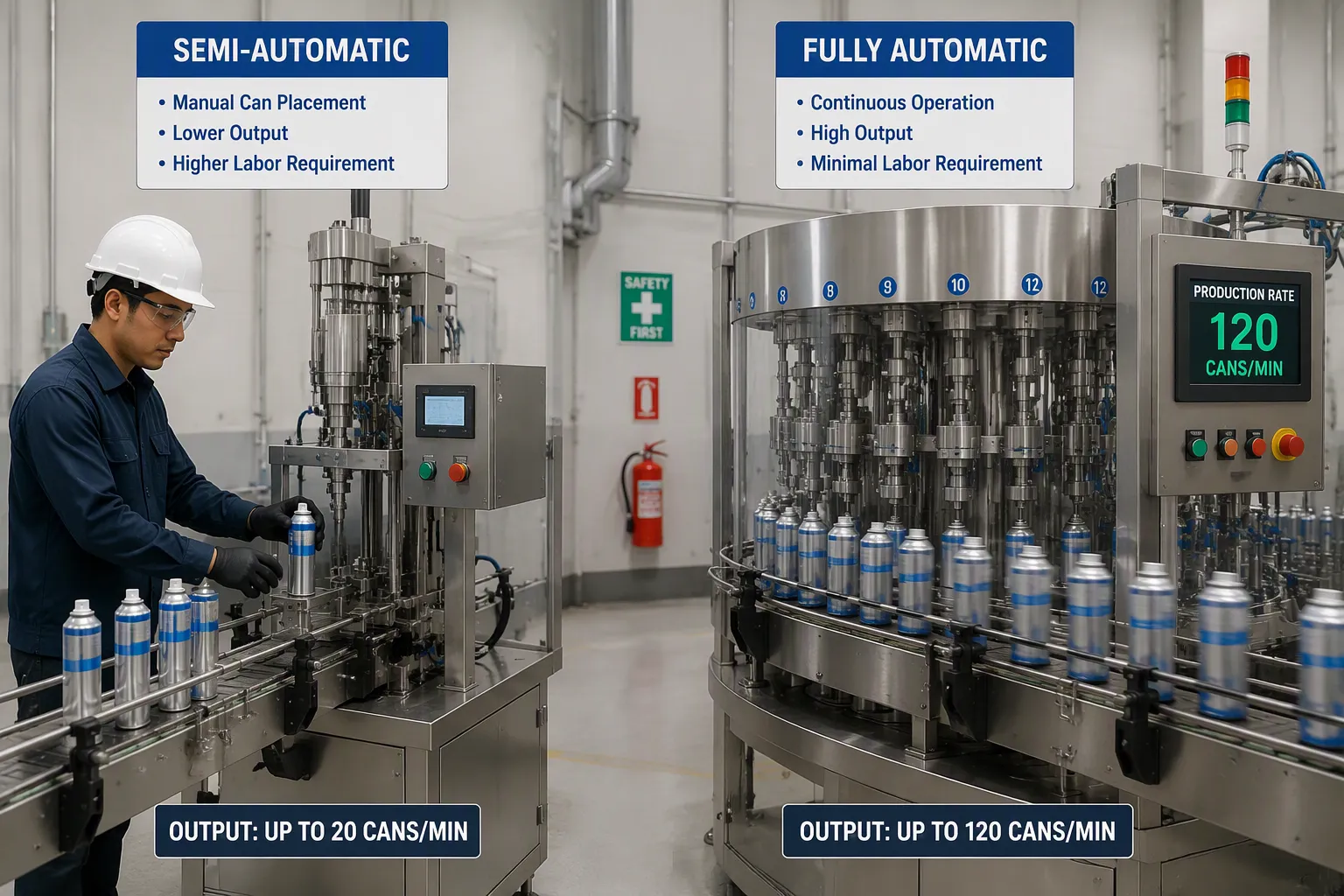
A semi-automatic aerosol filling machine handles the main jobs of filling and crimping your product on its own, but a person must load the cans and start each cycle. Think of it as a middle step between doing everything by hand and having a fully automated system. You put an empty can into the machine, push a button or step on a pedal, and the equipment does the exact liquid fill, propellant charge, and crimp. Then you take out the finished can and put in the next one. This setup gives you steady, precise results without needing a complex robotic line.
How It Works and Where People Step In
Loading and Removing Cans by Hand
Your worker stands at the machine and places each empty can into a special holder. Once the cycle ends, they pick up the filled can and move it aside. This hands-on step is what makes it semi-automatic. One person usually runs the whole process, so labor costs stay low while output remains steady. You do not need conveyor belts or robotic arms to move cans around. The worker acts as the link between each step.
Starting Each Fill Cycle Manually
The machine does not run by itself all the time. Instead, your worker starts each fill by pressing a switch or pedal. This control point helps with safety and accuracy. You can pause between cans, check the fill level, and fix things right away. The machine handles the exact liquid injection, the propellant gas fill, and the crimping seal with steady pressure. Your worker just decides when each cycle begins. This setup cuts down on waste because you spot problems early, before a whole batch goes through.
Main Features and Costs
Lower Starting Price
The upfront cost of a semi-automatic aerosol filling machine is much less than a fully automatic system. You also save on setup and floor space. Maintenance costs stay low. One industry report shows yearly upkeep between $300 and $800, thanks to the simpler design. Another source puts the number near $7,000 per year, which is still far below the $15,000 or more you might pay for a fully automatic line. Either way, your ongoing costs stay steady and easy to plan for.
Fast Switches Between Products
Changing from one can size or product formula takes just a few minutes. You adjust a few settings, swap a nozzle or crimping head, and you are ready for the next batch. This speed gives you great flexibility for short runs. You can test a new scent in the morning and make a batch of insect spray after lunch. No long setup or software changes slow you down.
Best Uses for Small to Medium Batches
Testing New Products and Research
Lab and trial runs need a machine that handles small amounts without wasting materials. A semi-automatic filling machine works perfectly here. You can make a few dozen cans to test market interest, check shelf life, or improve your formula. The filling stays accurate, so your test results match what a full-scale line would produce. This method protects your budget while you develop new items.
Specialty Products with Low Demand
Many industries use this equipment for niche items. Cosmetics companies make body deodorant, sunscreen, facial mist, and shaving foam in small batches. Drug makers create small-dose portable medicines and topical sprays. Household brands run air fresheners and insect sprays. Auto care firms fill refrigerants and carb cleaners. Food makers handle cooking oil sprays and whipped cream. These fields value the benefits of semi-automatic filling machines: lower cost, steady quality, and quick changes. You keep strong product quality without needing huge output. This balance makes the semi-automatic liquid filling machine a smart pick for growing businesses. The semi-automatic liquid filling machine also helps contract packagers who serve many clients with different products. Your production gets better because you spend less time on setup and more time on actual filling. Quality stays consistent across batches, giving you confidence in every can you send out.
What is an Automatic Aerosol Filling Machine?
An automatic aerosol filling machine is a full system. It does every step of filling without people helping. It feeds empty cans, fills them with liquid, adds gas, crimps the valve, and pushes out the finished can. People only watch the machine, add materials, and do upkeep. This machine is made for high-volume, nonstop production. You can run it for long shifts with very little downtime. The automatic machine gives you the same results across thousands of cans every day.
Fully Integrated Production Line Mechanics
Automatic Can Feeding and Indexing
The machine begins with a can magazine or belt that feeds empty cans by itself. Sensors spot each can and move it into a rotating holder. This holder takes the can to each station. You never have to touch the cans. The automatic feeding system makes sure the filling never stops because of missing cans. The timing system also sets when each can reaches the liquid fill, gas charge, and crimp stations. This exact timing is very important for smooth work.
Synchronized Propellant Charging and Crimping
In a full automatic line, the gas fill and crimp happen at the same time on different cans in the round system. While one can gets gas, another can gets its valve crimped. This timing removes slow points. The automatic liquid filling machine fills the product first. Then the gas station puts in the gas. Last, the crimp station seals the can. All steps happen in a nonstop circle. The machine keeps high speed without losing seal quality.
Advanced Features and Higher Throughput
PLC Control and Real-Time Monitoring
A programmable logic controller (PLC) runs the whole machine. It controls speed, fill amounts, pressure, and temperature. You can watch every setting on a touchscreen. If any station goes outside the set range, the PLC either fixes it or stops the line. This live watching makes production better. It also makes sure filling is exact, which is key for product quality. The PLC also saves data for quality checks and tracking.
Output Rates of Hundreds of Cans Per Minute
The biggest plus of an automatic aerosol filling machine is its speed. New round machines can fill 300 to 600 cans each minute. These systems move cans in a nonstop circle, so many steps happen at once. Older step-by-step systems can only do 80 to 150 cans each minute. With an automatic machine, you get high speed and high output. This speed helps you fill big orders fast. The good points of high output include lower cost per can and faster payback on your money.
Ideal Use Cases for High-Volume Manufacturing
Mass Production of Standardized Products
Automatic machines are great for products you make in large amounts with little change. Examples are air fresheners, bug sprays, deodorants, and shaving creams. These products need steady doses and even quality. The automatic machine gives this steadiness across millions of cans. You can trust the machine to keep the same fill weight and crimp force each time.
Industries Requiring Strict Quality Assurance
Industries like drugs, food, and car care often need tight quality control. An automatic liquid filling machine gives the exactness these areas need. It keeps product quality by holding exact fill amounts and good seals. The PLC also saves batch info for checks. For these industries, the automatic machine is key to meeting rules. The fill accuracy and steadiness of automatic machines lower the chance of recalls and waste.
Semi-Automatic vs Automatic Filling Machine: Key Differences
Choosing between these two machine types comes down to understanding how they differ across several critical dimensions. You need to examine speed, cost, flexibility, and labor requirements side by side. The table below gives you a quick snapshot of the main contrasts.
Comparison Factor
Semi-Automatic Line
Fully Automatic Line
Production speed
Dozens of cans per minute
Hundreds of cans per minute
Operator requirement
Minimum 1 person for the whole line
2–4 people for feeding and packing
Changeover time
Minutes
Longer, often requiring tooling swaps
Upfront cost
Lower capital investment
Higher capital investment
Labor cost per unit
Higher
Lower
Flexibility
High, easy product switching
Lower, best for standardized runs
Production Speed and Throughput Metrics
Cans Per Minute (CPM) Comparison
The most visible difference between these systems appears in their output rates. A semi-automatic aerosol filling machine typically produces dozens of cans per minute. You might achieve a range of outputs depending on your operator's speed and the product type. An automatic aerosol filling machine, however, reaches hundreds of cans per minute. Rotary systems can handle 300 to 600 cans per minute because multiple stations work simultaneously. This gap in production speed transforms your entire manufacturing timeline. A job that takes one full shift on a semi-automatic line might finish in under an hour on an automatic system.
Impact of Setup and Changeover Time
Your production volume and speed depend not only on raw output but also on how quickly you switch between products. Semi-automatic machines shine here. You can change can sizes or product formulas in just minutes. Adjust a few settings, swap a nozzle, and you resume production. Automatic filling machine setups take longer. You may need to change tooling, update PLC parameters, and run test cycles. This downtime matters if you handle many small batches. For long runs of a single product, the changeover penalty becomes less important because you spread that time across thousands of cans.
Cost Analysis and Return on Investment
Upfront Purchase Price vs. Long-Term Labor Savings
Your initial budget often drives the decision. A semi-automatic liquid filling machine costs significantly less upfront. You also save on installation and floor space. However, you pay more in labor over time. One operator handles the entire semi-automatic line. That person loads cans, starts cycles, and removes finished products. An automatic aerosol filling machine requires 1–2 operators for can feeding plus 1–2 operators for packing, totaling 2–4 staff members. While that seems like more people, each worker oversees far greater output. Your labor cost per can drops dramatically with automation. Calculate your annual production volume to see which option pays back faster.
Maintenance and Downtime Costs
Both machine types need regular upkeep, but the cost profiles differ. Semi-automatic systems have simpler designs with fewer moving parts. Annual maintenance might run between $300 and $800. Fully automatic lines involve more complex components, sensors, and PLC systems. Their maintenance costs run higher, potentially reaching $15,000 or more per year. Downtime also costs more with automation because you lose hundreds of cans per minute when the line stops. Semi-automatic lines recover quickly from minor issues. Automatic systems may require specialized technicians for repairs. Factor these ongoing expenses into your total cost analysis.
Flexibility and Labor Requirements
Adaptability to Different Can Sizes and Products
Your product mix heavily influences which machine suits your operation. Semi-automatic equipment offers outstanding flexibility and changeovers. You can test a new fragrance in the morning and produce insect spray after lunch. This adaptability serves contract packagers and specialty manufacturers well. Automatic systems handle standardized products more efficiently. Once configured for a specific can size and formula, they run consistently for hours. Changing products requires more time and planning. If you produce large volumes of similar items, this limitation matters little. If you serve diverse clients with varied needs, the semi-automatic approach gives you greater agility.
Operator Skill Level and Training Needs
The filling process demands different skill levels from your team. Semi-automatic machines require operators who understand the equipment and can spot quality issues. Training takes a few days. Your worker controls the pace and checks each can. Automatic systems need staff who can monitor PLC screens, interpret alerts, and perform basic troubleshooting. Operator training takes longer, but the daily work involves less physical effort. Both systems require attention to product quality. The automatic liquid filling machine maintains accuracy and consistency through precise electronic controls. The semi-automatic liquid filling machine relies more on your operator's vigilance. Your workforce's technical comfort level should factor into your decision.
The right choice balances your production targets against your available capital and labor. A semi-automatic aerosol filling machine serves smaller operations well. An automatic aerosol filling machine rewards businesses with high volume and steady demand. Your production efficiency depends on matching the equipment to your actual needs. Consider your growth trajectory carefully before committing to either path.
How to Choose the Right Aerosol Filling Machine
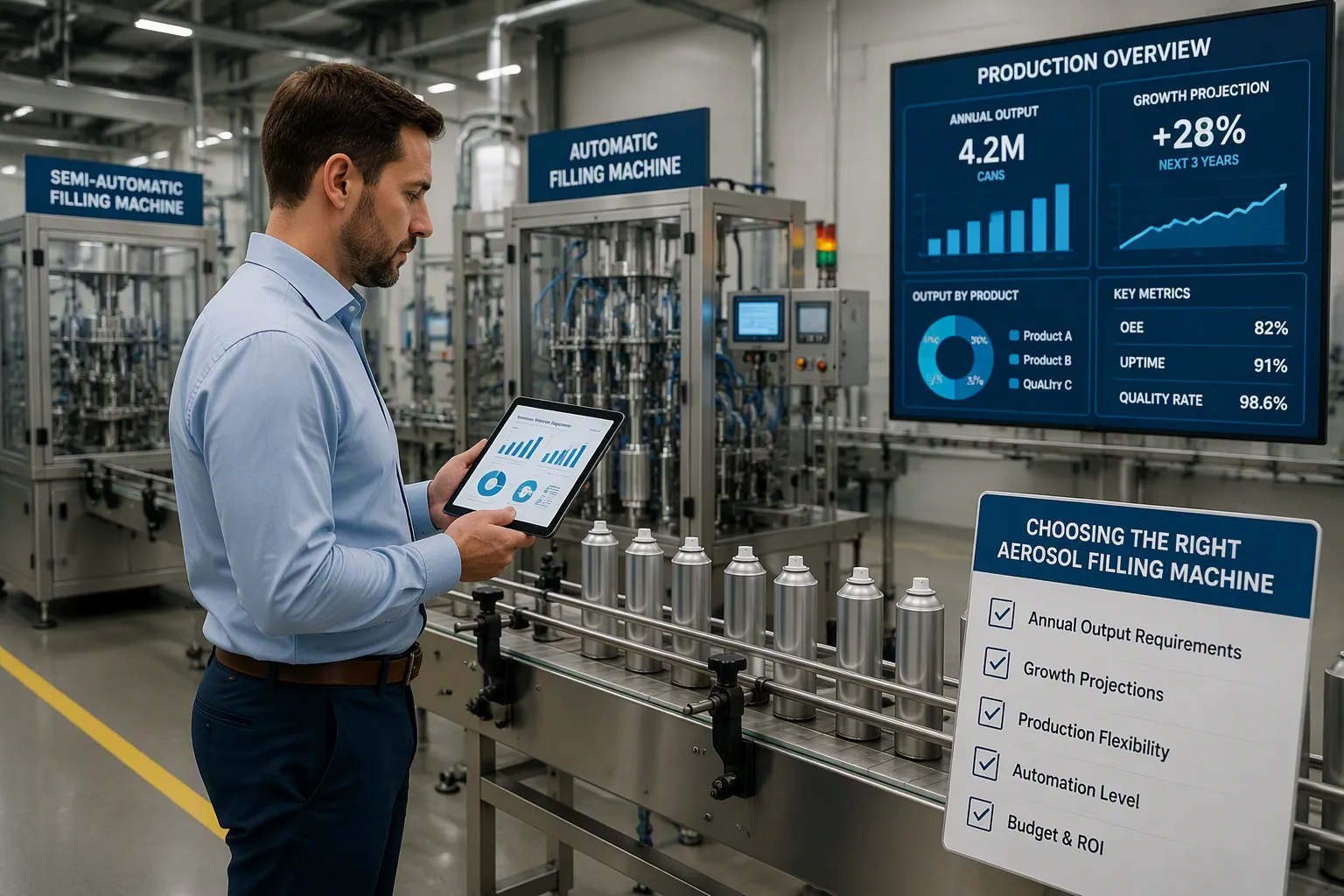
To pick between a semi-automatic and an automatic aerosol filling machine, you need to check your numbers carefully. You need a way to decide based on your yearly output, product mix, and space limits. This section explains each factor. If you already use a semi-automatic line and have slowdowns during busy times, these same questions will tell you if an upgrade makes sense. Knowing how to choose between semi-automatic and automatic starts with true production data.
Assessing Your Production Volume and Growth Plans
Your current output and future goals are the base for this choice. You cannot make a good decision without knowing your real numbers.
Calculating Current and Projected Annual Output
Start with your yearly can count. Look at your total output from the last 12 months. Add your expected growth for the next two years. Industry standards give you a helpful guide. One source says the yearly break-even range for general aerosol filling machines is between 960,000 and 1,800,000 cans per year. This number comes from a monthly range of 80,000 to 150,000 cans. For Bag-on-Valve systems, the break-even point is lower at 500,000 to 600,000 units per year.
Compare your volume to these ranges using this table:
Annual Output
Recommended Machine Type
Under 500,000 cans
Semi-automatic provides better value
500,000 – 960,000 cans
Consider your growth plan carefully
960,000 – 1,800,000 cans
Automatic starts to make financial sense
Over 1,800,000 cans
Automatic is the clear choice
These ranges give you a place to start. Your specific product mix and labor costs may change the numbers a little. The goal is to match the machine type to your real production needs.
Evaluating Peak Season Demands
Many aerosol product types have seasonal spikes. Air fresheners sell more in spring and summer. Insect sprays peak in warm months. Auto care products often see demand around season changes. A semi-automatic aerosol filling machine handles these spikes by adding more shifts or overtime. Your extra labor cost only happens during busy times. An automatic aerosol filling machine handles the same spikes without adding workers. It runs faster and meets higher demand during normal work hours. If your peak volume pushes your output above the break-even range, automation becomes more attractive. If your base production stays low and spikes are short, a semi-automatic line may still work well for you. Your production speed during peak times directly affects your profit.
Evaluating Labor Costs and Automation Goals
Labor is a big ongoing cost in any filling operation. Your local wage rates and long-term staffing plan matter here.
Cost-Benefit Analysis of Reducing Manual Oversight
A semi-automatic liquid filling machine needs one operator for the whole line. That person loads cans, starts cycles, and checks product quality. Your labor cost per can stays higher because output per worker is lower. An automatic liquid filling machine needs two to four workers for can feeding and packing. But each worker oversees much more output. Your labor cost per can drops a lot. Find your yearly labor cost for each option. Multiply your hourly wage by the hours needed to make your yearly volume. Add overtime costs during peak seasons. The difference often makes the higher upfront cost of automation worth it. This analysis helps you protect both quality and your budget.
Aligning with Industry 4.0 and Smart Factory Trends
Modern factories move toward data-based work. An automatic filling machine with PLC control fits this model well. It records fill weights, cycle counts, and alarm events. You can look at this data to make production better and cut waste. A semi-automatic system does not have this level of integration. It still gives product quality and consistency, but you collect less process data. If your long-term plan includes smart factory features, the automatic path gets you ready for that future. The consistency of an automatic line also helps stronger product quality across every batch.
Considering Space and Facility Constraints
Your building sets limits on what equipment you can put in. Measure your available space before making a final choice.
Footprint Requirements for Inline vs. Rotary Systems
Semi-automatic machines have a small footprint. They fit into smaller production rooms and let you change things easily. You can set one up in a small space. Automatic rotary systems need more floor space. A full line with can feeding, filling stations, and packaging setup may need a larger area. Measure your building and think about aisles, material storage, and worker movement. Space limits may force your choice no matter what your volume is.
Utility Needs (Air, Power, and Ventilation)
Both machine types need compressed air and electric power. Automatic systems use more of both. Check your current air compressor size. An automatic line may need a bigger compressor or a separate supply line. Ventilation is very important for any aerosol work. Propellant gases need good exhaust to keep safe air quality. Your local fire and safety rules may set specific needs. Include these utility upgrades in your total project cost. Good planning makes sure your building supports the equipment you pick.
Your choice comes down to matching your production needs with your available resources. The right machine balances current output, growth plans, labor strategy, and space limits. If you have slowdowns with your current setup, these factors guide your upgrade path.
Wejing Intelligent Equipment Solutions for Every Scale
When you look for the right equipment partner, you want a maker that knows both sides of the market. Guangzhou Wejing Intelligent Equipment Co., Ltd. brings over 10 years of know-how to the filling machinery field. The company builds semi-automatic aerosol filling machine options for small businesses and automatic aerosol filling machine systems for high-volume makers. Their engineers also focus on Bag-on-Valve (BOV) technology, which keeps your product apart from the propellant for better purity.
Full Range of Aerosol Filling Machines
Standard Aerosol Lines and BOV Technology
Wejing offers several standard automatic lines to fit different output goals. The QGJ50 works as a 4-in-1 automatic filling machine. The QGJ70 handles paint, insecticide, and lubricating aerosols with ±1% accuracy at 60–70 cans per minute. For bigger operations, the QGJ120 delivers high-speed production. The WJER-60 and WJER-80 models lead their BOV product group. These machines handle the special bag-on-valve process with care.
The table below shows specs for their BOV semi-automatic and small-scale lines:
Model
Key Feature
Capacity
Liquid Filling Range
Gas Filling Accuracy
Liquid Filling Accuracy
Can Diameter
Can Height
Valve Size
WJER-300S
Split-type design
10–15 cans/min
30–300 ml
±0.03 MPa
≤±1%
35–70 mm
70–330 mm
25.4 mm (1" BOV)
WJER300
Compact, single worktable
10–15 cans/min
30–300 ml
±0.03 MPa
≤±1%
35–70 mm
70–330 mm
25.4 mm (1" BOV)
WJERZ300
Outer-crimping for plastic bottles
10–15 cans/min
30–300 ml
±0.03 MPa
≤±1%
35–70 mm
70–330 mm
25.4 mm (1" BOV)
WJERZ-150
For 20mm BOV valves
10–15 cans/min
2–60 ml
±0.03 MPa
≤±1%
25–35 mm
58–330 mm
20 mm BOV
Shaving Gel Machine
Supports post-foaming
300–600 cans/hour
30–650 ml
±0.03 MPa
≤±1%
35–70 mm
70–330 mm
25.4 mm (1" BOV)
Custom Setups for Specific Products
Your product line may not fit a standard design. Wejing handles this with customization. You can pick standard features with optional add-ons. You can also ask for fully custom turnkey production lines. Modular equipment can stand alone or join a full line. This flexibility lets you match the machine to your exact product needs.
Turnkey Production Line Setup
Mixing, Filling, and Packaging in One Package
A single machine only fixes part of your problem. Wejing builds complete turnkey aerosol production lines that cover every step. Their work includes line design, equipment choice, setup guidance, operation training, and after-sales support. You get one connected system where each part works with the next. This setup boosts your overall efficiency and cuts the friction between separate steps.
Setup, Training, and After-Sales Help
Your team needs proper prep to run new equipment well. Wejing offers setup guidance so your line starts right. They give operation training that builds your staff's skills. After-sales support means you have help when issues come up. This full-service method protects your investment and keeps your production moving smoothly.
Global Know-How and Client Success Stories
Serving Auto Care, Personal Care, and Household Brands
Wejing serves many industries. Their equipment makes refrigerants, carb cleaners, air fresheners, personal perfumes, hairsprays, and food spray oils. Each field needs different standards for quality and consistency. Wejing's machines deliver the accuracy these varied products require.
Wejing provides turnkey aerosol production line services including line design, equipment selection, installation guidance, operation training, and after-sales support. This full-service approach helps clients achieve efficient production with steady performance.
Your choice between machine types comes down to your specific needs. A semi-automatic aerosol filling machine offers lower upfront costs and quick changeovers for small batches. An automatic aerosol filling machine delivers unmatched speed and consistency for high-volume runs. Your production volume, labor costs, and growth plans determine the right fit.
Consider your current bottlenecks honestly. If you face slowdowns during peak seasons, automation may boost your production efficiency. Both options protect quality when operated correctly. Leading manufacturers like Wejing Intelligent Equipment provide scalable solutions. You can start with a semi-automatic line and upgrade later as demand grows. This flexibility protects your investment while supporting your product quality goals.
Assess your annual output and consult equipment experts. They help you find the perfect match for your business objectives.
FAQ
How do I know if my production volume justifies an automatic aerosol filling machine?
First, figure out how many cans you make each year. If you make fewer than 500,000 cans, a semi-automatic line gives you more value for your money. If you make between 500,000 and 960,000 cans, think hard about your growth plans. Once you pass 960,000 cans, automation starts to make financial sense. Your production speed plays a big part in this math.
What safety features should I look for in aerosol filling equipment?
Look for parts that won't spark and cause explosions, plus good ventilation hookups. Your machine needs emergency stop buttons and pressure relief valves. Make sure guards on the crimping head keep operators safe from moving parts. Ask the maker about meeting local safety rules for flammable propellants.
Can I upgrade from a semi-automatic to a fully automatic system later?
Yes, you can grow step by step. Many makers build modular systems that let you add automatic feeding and indexing stations later on. Wejing Intelligent Equipment sells both machine types, so you can begin small and expand when demand rises. This path protects your first investment while leaving room for future growth.
How much floor space do I need for each machine type?
A semi-automatic aerosol filling machine has a small footprint, typically fitting in a compact area. Fully automatic rotary systems require more floor space. Measure your space before you decide. Remember to include room for storing materials, moving workers, and reaching the machine for repairs.
What training do my operators need for each system?
Semi-automatic machines need basic training that takes a few days. Your operator learns to load cans, start cycles, and catch quality problems. Automatic systems need more technical training. Staff must read PLC screens, understand alerts, and fix basic issues. Plan for longer training time with automation.
How does product changeover time differ between the two systems?
Semi-automatic machines switch products in minutes. You change settings, swap nozzles, and start filling again. Automatic systems take longer because you must change tooling and update PLC settings. For many small batches, semi-automatic equipment works better. For long runs of one product, the changeover delay matters less.
What maintenance schedule should I expect for aerosol filling machines?
Semi-automatic systems need simpler care with fewer moving parts. Yearly maintenance costs run from $300 to $800. Fully automatic lines need more attention because of complex sensors and PLC parts. Plan for higher upkeep costs and possible downtime with automation. Regular preventive care keeps your product quality strong.
How does fill accuracy compare between semi-automatic and automatic systems?
Both systems give excellent accuracy when set up right. Semi-automatic machines depend more on operator attention to catch problems. Automatic systems use PLC controls to keep fill weights steady on their own. Wejing's BOV models reach liquid filling accuracy within ±1 percent. Your quality needs decide which level of control fits best.