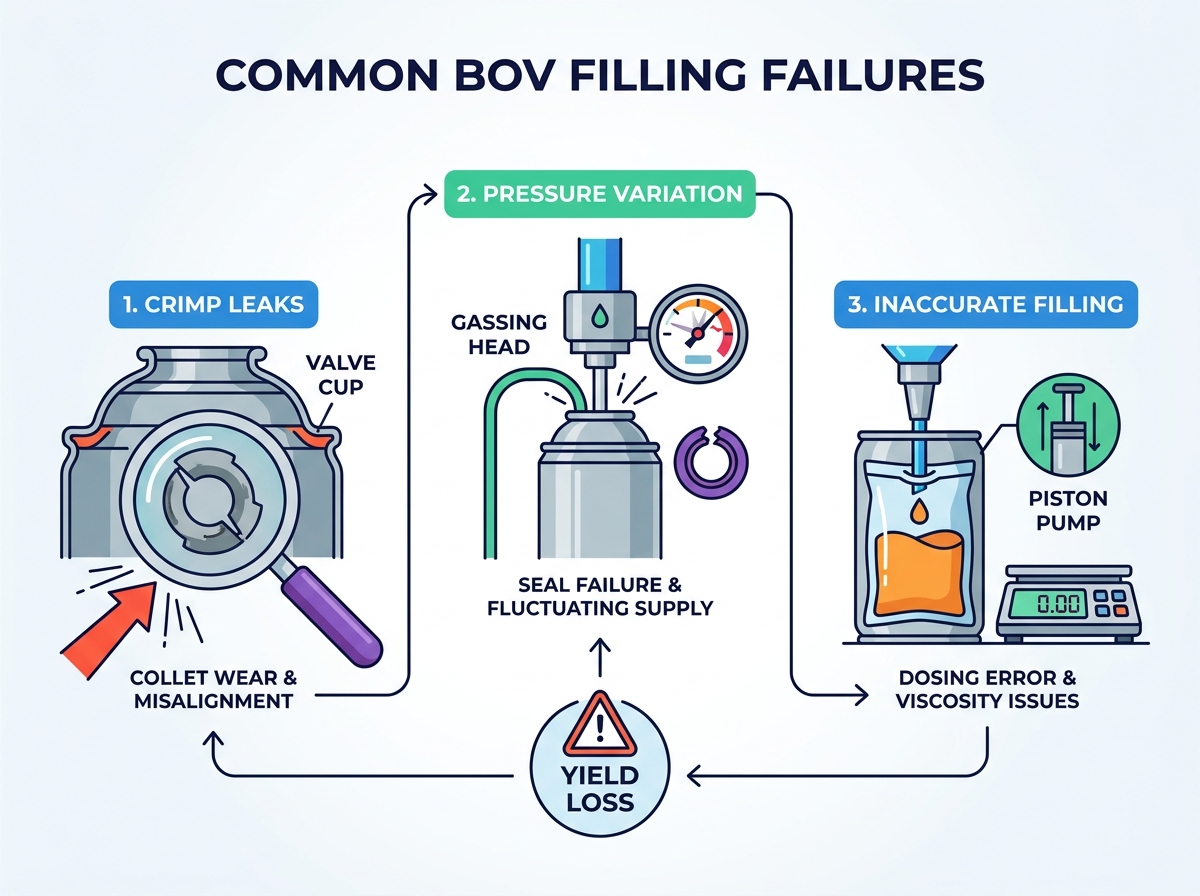
Bag-on-Valve (BOV) technology offers an exceptional, high-yield packaging solution for modern manufacturers. However, it quickly becomes a severe margin liability when mechanical inconsistencies arise on the production floor. BOV systems safely separate your valuable product from the propellant. The actual filling process demands zero-tolerance precision. Operators must meticulously manage crimping, gassing, and liquid dosing to avoid catastrophic waste. Even a minor calibration error ruins entire batches and disrupts supply chains.
We designed this guide to provide a clinical, technical breakdown of the three most common BOV production failures. You will learn how to accurately diagnose crimp leaks, pressure variations, and inaccurate liquid filling. We also provide a practical decision framework. This helps you determine if these recurring failures stem from simple operational errors, standard component wear, or systemic machinery limitations. You can then take precise corrective action to restore overall line profitability.
Key Takeaways
Crimp leaks are rarely random; they are typically a verifiable symptom of crimp collet wear, improper depth/diameter calibration, or incompatible valve tinplates.
Pressure variations during under-the-cup gassing usually point to failing seal rings or fluctuating pneumatic supply lines, directly impacting aerosol spray performance.
Inaccurate liquid filling often results from piston pump drift, fluctuating product viscosity, or improper bag expansion during the injection phase.
Recurring failures despite routine maintenance indicate it is time to evaluate the structural capabilities of your bag-on-valve filling equipment against your production volume and compliance needs.
The Business Cost of Unresolved BOV Production Issues
Yield Loss & Scrap Rates
Micro-errors compound rapidly during high-volume aerosol production. A seemingly negligible 2% leak rate combined with a 1% underweight dosing rate destroys profit margins over time. When operators fail to catch these deviations early, they scrap thousands of cans per shift. You lose the raw aluminum, the internal valve assemblies, the compressed gas, and the bulk product itself. This yield loss demands immediate diagnostic attention before it erodes your monthly revenue.
Safety & Compliance Risks
Propellant leakage presents severe regulatory and safety implications. Even inert gases like nitrogen or compressed air create hazardous pressure differentials if they escape during transit. Furthermore, improper dosing in cosmetic, pharmaceutical, or food-grade environments directly violates cGMP (Current Good Manufacturing Practice) standards. Regulatory bodies require strict documentation of fill weights and seal integrity. Compromised cans invite microbial contamination, risking costly recalls and legal liabilities.
Brand Reputation
End-user experience dictates your retail success. Unresolved BOV issues directly impact consumers. They experience weak spray patterns, dead cans, or premature product spoilage. A customer paying for a premium continuous-spray sunscreen expects flawless execution. When cans fail to dispense, buyers leave negative reviews and switch to competitors. Retail buyers monitor these defect rates closely. Consistent quality failures will quickly cost you lucrative shelf space and buyer retention.
Diagnosing and Resolving Crimp Leaks
Mechanical Realities of Crimping
You must establish a perfect mechanical seal between the 1-inch valve cup and the can neck. Crimping depth and crimping diameter represent the two most critical variables in this process. The crimp collet expands outward to lock the valve cup under the can curl. If the depth rests too high, the seal lacks compression. If the diameter expands too narrowly, propellant escapes through microscopic gaps.
Common Root Causes
Worn or uncalibrated collets: Continuous metal-on-metal friction degrades collet jaws over millions of cycles.
Inconsistent downward pressure: Pneumatic crimping heads often lose force if air supply lines fluctuate.
Dimensional mismatch: Tinplate valve cups and aluminum cans possess different material tolerances, requiring distinct crimp settings.
Diagnostic Steps
We recommend mandating routine water bath testing for all production batches. Submerge cans in warm water to visually identify ascending bubbles escaping from the valve seam. Next, utilize digital crimp gauges to verify physical dimensions against manufacturer specifications. Measure both the depth and the internal diameter. Document these readings systematically to identify gradual mechanical drift before catastrophic leaks occur.
Diagnostic Parameter
Standard Target Range
Symptoms of Calibration Failure
Crimp Depth
4.70 mm - 5.00 mm
Weak mechanical seal; visible bubbling in the water bath.
Crimp Diameter
27.10 mm - 27.30 mm
Deformed valve cup; structural micro-leaks under pressure.
Downward Force
Determined by can material
Crushed can necks or insufficient gasket compression.
Corrective Actions
Recalibrate the mechanical limits on your crimping head using a master calibration can.
Adjust the pneumatic cylinder pressure to ensure consistent downward force across every index cycle.
Replace crimping collets and expanding jaws proactively before dimensional wear exceeds acceptable tolerance limits.
Switch to hardened steel tooling if you process thick tinplate cups frequently.
Managing Pressure Variation in Under-the-Cup Gassing
The Gassing Mechanism
The under-the-cup gassing phase dictates the internal pressure of the final product. The machine lowers a centering bell over the can. A vacuum removes ambient air. The system then injects propellant (usually compressed air or nitrogen) beneath the valve cup just milliseconds before the crimping jaws seal the package. Precision timing here remains non-negotiable.
Common Root Causes
Degraded sealing rings: Vacuum and pressure gaskets on the gassing head suffer micro-abrasions, allowing propellant to escape prematurely.
Fluctuating main air supply: Factory air compressor output often drops during peak usage hours, starving the gassing head of necessary volume.
Can misalignment: If the centering bell does not seat perfectly perfectly flush against the can dome, the high-pressure gas blows out the side.
Diagnostic Steps
Begin by auditing your inline pressure regulators. Check the supply pressure at the main compressor and compare it against the localized pressure gauge on the gassing head. A significant drop indicates supply line starvation. Inspect the polyurethane sealing gaskets inside the centering bell using a flashlight and magnifying lens. Look for tears, micro-abrasions, or permanent compression set.
Corrective Actions
Implement localized air reservoirs (surge tanks) directly next to the gassing station to absorb factory pressure fluctuations.
Upgrade to harder-wearing seal materials, such as Viton or reinforced PTFE, for extended operational lifespans.
Calibrate your Programmable Logic Controller (PLC) pressure sensors weekly.
Realign the indexing star-wheel to ensure perfect concentricity between the can and the gassing bell.
After sealing and pressurizing the can, the machine forces your bulk product through the tiny valve stem and into the internal bag. This high-pressure liquid injection phase must expand the rolled bag smoothly. The dosing cylinder must deliver an exact volumetric amount of fluid. Any deviation results in underweight rejects or burst internal bags.
Common Root Causes
Piston pump seal degradation: Worn internal seals allow fluid to bypass the piston, delivering short fills.
Changes in product viscosity: Temperature fluctuations in your holding tank alter fluid dynamics, causing the pump to struggle.
Bag folding or ruptures: Excessive injection speed forces the internal bag to twist, fold, or tear inside the can.
Diagnostic Steps
Implement rigorous Statistical Process Control (SPC) protocols. Use inline check-weighers to monitor every single can exiting the dosing station. Analyze the weight distribution curves to spot gradual drift versus sudden mechanical failures. Cut open rejected cans carefully. Inspect the internal bags. A burst bag typically points to excessive injection pressure, while a twisted bag indicates incompatible valve-to-bag structural designs.
Corrective Actions
Adjust your injection flow rates via the PLC to allow the internal bag sufficient time to unfurl smoothly.
Install jacketed holding tanks to stabilize bulk product temperatures, ensuring consistent viscosity entering the dosing pump.
Calibrate the dosing cylinder stroke lengths using sterile water before introducing complex chemical formulations.
Replace internal pump seals routinely during scheduled preventative maintenance windows.
Decision Framework: When to Upgrade Your Bag-on-Valve Filling Equipment
Fix vs. Replace Logic
Operators must differentiate between normal wear-and-tear and systemic machine inadequacy. Replacing a worn collet or a degraded seal represents basic maintenance. However, if you constantly fight drifting fill weights, endless changeover delays, and erratic pressure drops, you face a capital expenditure issue. Outdated architecture simply cannot sustain high-speed, modern production demands. Transitioning to reliable, modern bag-on-valve filling equipment often provides the only permanent resolution to chronic scrap rates.
Evaluating Current Equipment Limits
Assess your existing machinery across three distinct operational pillars:
Precision & Consistency: Pneumatic-driven mechanisms rely on air pressure, which naturally fluctuates. Servo-driven mechanisms utilize precision electric motors. Servo motors offer infinitely tighter tolerances for crimp depth and liquid dosing accuracy.
Scalability: Semi-automatic machines work well for pilot runs. However, bridging the gap to fully automatic index lines often multiplies failure rates if the underlying chassis lacks rigidity.
Changeover Efficiency: Track the exact time your technicians require to switch between different can sizes or product types. Long, difficult changeovers utilizing manual hand-tools indicate outdated architecture.
Evaluating New Solutions
When sourcing new machinery, demand absolute transparency regarding OEM testing protocols. Require rigorous Factory Acceptance Testing (FAT) and Site Acceptance Testing (SAT) parameters before signing off. Assess the availability of local technical support and rapid replacement parts. Finally, verify strict compliance readiness. Your new setup must meet ATEX standards for flammable zones if you plan to process volatile propellants, and feature sanitary welds for pharmaceutical or food-grade applications.
Conclusion
Crimp leaks, pressure drops, and dosing inaccuracies represent solvable mechanical challenges. They are not inherent flaws of BOV technology. By understanding the mechanical realities of crimping collets, under-the-cup gassing dynamics, and high-pressure liquid injection, your team can troubleshoot effectively. Proactive diagnostics prevent minor calibration drifts from escalating into massive batch failures. Standardized water bath testing, digital dimension verification, and strict SPC check-weighing build a robust defense against yield loss.
We encourage operational managers to conduct a comprehensive 30-day downtime and scrap rate audit. Measure the exact volume of wasted product, lost aluminum, and labor hours spent fighting outdated machinery. This data reveals the true operational efficiency of your current setup. If your existing line continually bottlenecks your growth, it is time to source a modern, servo-driven solution. Please feel free to contact us to discuss how advanced mechanical architecture can eliminate your recurring production failures permanently.
FAQ
Q: What is an acceptable leak rate in BOV manufacturing?
A: Industry standard aims for absolute zero. Practically, facilities accept a leak rate of less than 0.1% post-water bath testing. Anything higher requires immediate equipment intervention and recalibration of your crimping head.
Q: Can standard aerosol filling machines be converted for Bag-on-Valve?
A: Generally no. BOV requires specific under-the-cup gassing heads and highly specialized, high-pressure through-the-valve liquid dosing cylinders. Standard aerosol machinery lacks this necessary architecture, making specialized BOV equipment mandatory.
Q: How often should crimping collets be replaced on BOV machines?
A: Replacement frequency varies by material and cycle count. Standard preventative maintenance suggests meticulous inspection every 1 to 2 million cycles. You must replace the collets immediately upon any sign of dimensional drift or scoring.
Q: Does the type of propellant affect BOV machine performance?
A: Yes. Compressed air and nitrogen behave differently under pressure. Equipment regulators and gassing head timers must be precisely calibrated to the specific gas utilized to avoid pressure variations and ensure consistent spray performance.