Upgrading or establishing an aerosol edible oil production line demands strict precision engineering. You simply cannot rely on standard aerosol systems to process sensitive culinary liquids like olive, avocado, or canola oil. These edible oils present unique fluid dynamics and remain highly susceptible to rapid oxidation. Manufacturers face intense pressure to maintain purity. You need specialized equipment that completely isolates propellants from the product to ensure food safety and prevent contamination. In this article, we move beyond basic theory to examine the exact technical configurations required to overcome daily operational constraints. We will explore how to evaluate different machine setups, optimize high-pressure liquid dosing, and meet stringent hygiene standards. By the end, you will understand how to build a high-yield, food-safe production line using a reliable bag-on-valve filling machine for oil spray.
Key Takeaways
Viscosity dictates configuration: Edible oils require specific liquid-filling nozzle geometries and pressure settings to maintain dosing accuracy and prevent drip.
Automation scalability is a primary cost driver: Selecting between semi-automatic, indexing linear, or rotary systems depends on throughput requirements and expected ROI timelines.
Food-grade compliance is non-negotiable: Equipment must feature sanitary welds, 316L stainless steel contact parts, and integration capabilities with Clean-in-Place (CIP) systems.
Factory Acceptance Testing (FAT) minimizes rollout risk: Validating bag sealing integrity and propellant pressure thresholds before facility installation prevents costly production bottlenecks.
The Technical Requirements of Edible Oil Packaging
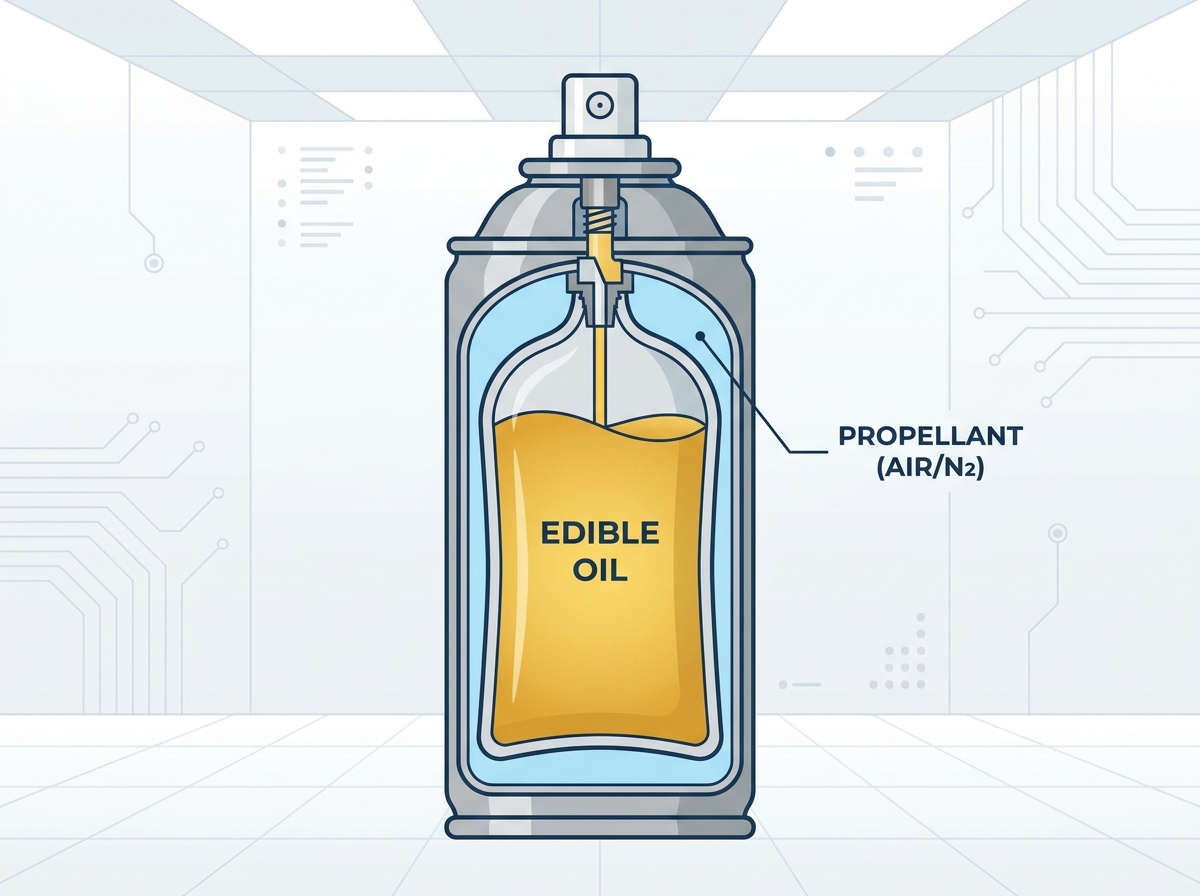
Standard aerosol technology fails miserably for culinary oils. Traditional systems mix the chemical propellant directly into the liquid. This design causes rapid oxidation. It ruins the delicate flavor profile of premium olive or avocado oils. You must separate the gas from the product. Bag-on-valve (BOV) technology solves this critical problem entirely.
The system places the oil inside a hermetically sealed laminated pouch. The machine then injects compressed air or nitrogen into the can. This gas sits outside the pouch. When a consumer presses the actuator, the gas squeezes the bag. It dispenses the oil purely without any chemical mixing. This separation extends shelf life naturally.
Oil viscosity changes heavily based on your facility temperature. Cold environments make cooking oils thicker. Thick oils resist flowing smoothly through narrow valves. You need temperature-compensated liquid dosing systems. These systems maintain precise accuracy despite ambient temperature swings. If you ignore viscosity changes, your dosing weights will fluctuate wildly.
Commercial markets expect a 99% product evacuation rate. Consumers hate wasting expensive premium oils. Machine calibration dictates this evacuation metric directly. If you under-pressurize the external propellant, the bag will not squeeze fully. You must strictly monitor your gas pressure gauges to ensure complete product dispensing.
Evaluating the Right Bag-on-Valve Filling Machine for Oil Spray
You must match your machine architecture to your specific production volume. Selecting the wrong platform causes massive bottlenecks. It also leads to unnecessary mechanical wear. We evaluate three primary automation tiers for oil spray manufacturing.
Semi-Automatic BOV Systems
These units require manual intervention for can placement. An operator moves the can from the gassing station to the liquid filling station.
Best for: Pilot runs, low-volume specialty oils, or startup operations.
Limitations: Manual can-handling introduces operator fatigue. This leads to highly variable cycle times. You cannot rely on these for consistent large-scale output.
Automatic Linear/Indexing Machines
Indexing machines use automated conveyors to move cans. They stop at specific stations for gas flushing, liquid filling, and weight checking.
Best for: Mid-tier production. They balance automated conveying with modular processing.
Key Feature: Programmable Logic Controller (PLC) integration. This allows for verifiable recipe management. Operators can save pressure settings for different oil types.
High-Speed Rotary Systems
Rotary machines never stop moving. The cans travel in a continuous circular motion while being filled and gassed simultaneously.
Best for: Enterprise-scale, continuous production requiring high throughput. They easily process 60+ cans per minute.
Implementation Reality: They require massive upfront capital. You must also implement rigorous changeover protocols when switching between different oil types or can sizes.
Machine Category
Primary Application
Operator Dependency
Throughput Expectation
Semi-Automatic
Startup / R&D
High (Manual handling)
10-15 cans per minute
Linear / Indexing
Mid-Market Growth
Low (Monitoring only)
30-50 cans per minute
Continuous Rotary
Enterprise Production
Minimal (Supervisory)
60+ cans per minute
Critical Equipment Setup Parameters and Evaluation Criteria
Machine hardware alone does not guarantee a successful production run. You must configure the mechanical parameters precisely. Culinary oils demand exact tolerances. Even minor deviations lead to leaking cans or inaccurate fills.
Under-the-Cup Gassing and Sealing Accuracy:
The crimping depth and diameter determine the seal integrity. The machine forces gas under the valve cup and immediately crimps it shut. Poorly calibrated crimping leads to micro-leaks of the compressed nitrogen or air. You lose propellant pressure over time. Evaluation standard: Look for systems with micro-metric adjustments for crimping heads. These allow precise tightening without distorting the aluminum can.
High-Pressure Liquid Dosing:
You must force viscous oils through a tiny valve stem into the internal bag. This process encounters massive fluid resistance. You cannot use standard gravity fillers. Requirement: High-pressure metering cylinders are necessary to overcome internal bag resistance. These are often servo-driven. Servo motors allow you to ramp up pressure gradually. This prevents rupturing the delicate internal valve.
Propellant Selection Integration:
You must choose between compressed air and nitrogen. Nitrogen displaces oxygen better, further protecting the oil from degradation. The machine setup differs slightly for each gas. Crucial step: You must implement strict gas filtration standards. The machine must route all propellants through sterile filters before injection. This ensures a clean food environment.
Implementation Risks: Hygiene, Compliance, and Line Integration
Food safety audits leave zero room for error. When processing edible oils, your equipment must exceed basic industrial standards. Hygiene dictates your machine engineering choices. You must protect the consumer from bacterial growth and chemical contamination.
Sanitary Design and Material Standards
Food-grade compliance dictates the materials used in your machine. All liquid-contact pathways must consist of 304 or 316L stainless steel. Standard steel will rust when exposed to certain cleaning agents. Furthermore, standard rubber seals degrade rapidly when exposed to culinary oils. You must ensure the manufacturer uses FDA or CE-compliant food-grade seals. PTFE and Viton offer excellent chemical resistance. They will not break down or leach into your premium oils.
Clean-in-Place (CIP) Capabilities
Changeovers introduce massive contamination risks. Consider bottling avocado oil immediately after a run of garlic-infused olive oil. If residual garlic oil remains in the pistons, it ruins the avocado oil batch. The machine must support rapid, verifiable flushing. CIP systems automate this cleaning cycle. They pump hot water and sanitizers through the dosing cylinders automatically. You need machinery designed without dead legs or crevices where old oil can hide.
Quality Control Checkpoints
You cannot blindly trust the filling process. Mechanical wear eventually causes dosing drifts. You must integrate automated inline check-weighers. These machines weigh every single can. They reject any can falling outside the net-weight labeling regulations. Additionally, you must install water-bath leak detectors. These submerge the pressurized cans in warm water. If bubbles appear, the can is leaking. This prevents unsafe products from reaching retail shelves.
Vendor Shortlisting Logic and Procurement Next Steps
Procuring a packaging line requires deep technical alignment with your manufacturer. Do not buy off-the-shelf solutions blindly. You must interrogate the vendor's engineering capabilities. Treat the procurement phase as a long-term partnership evaluation.
Assess Engineering Support
Prioritize manufacturers who offer detailed layout engineering. They must demonstrate a deep understanding of cooking oil fluid dynamics. Ask them how they handle high-viscosity fluids at low ambient temperatures. If they cannot answer confidently, look elsewhere. When evaluating these engineering parameters, feel free to contact our technical team for expert guidance.
Demand Rigorous FAT Protocols
Never accept delivery before completing a Factory Acceptance Test (FAT). You must insist on running your specific oil during this test. Supply your exact bag-on-valve components and cans. Verify their speed and accuracy claims on the factory floor. If the machine fails to hit 99% evacuation during the FAT, do not authorize shipment. Fixing mechanical flaws post-installation causes devastating production bottlenecks.
Service Level Agreements (SLAs)
Machinery requires constant maintenance. Dosing seals degrade over time. Crimping collets wear down after thousands of cycles. Evaluate the vendor's availability of replacement wear parts. You need assurances they hold stock locally or can ship overnight. Furthermore, prioritize vendors offering remote diagnostic support via PLC. If your machine faults, a remote engineer can often log in and fix the software issue instantly.
Conclusion
Transitioning to or scaling up edible oil spray production requires a strict focus on precision engineering. Standard aerosol equipment cannot handle the viscosity or hygiene requirements of culinary oils. You must prioritize precision dosing, sanitary design, and reliable gas sealing over the initial machine cost. High-pressure servo pistons and micro-metric crimping heads dictate your ultimate product quality. Cutting corners on these components leads to leaking cans and oxidized oils.
Your actionable next step is simple. Define your exact target throughput in cans per minute. Document your oil viscosity specifications at your facility's baseline temperature. Finally, finalize your preferred can dimensions. Gather this data before initiating any vendor RFQs. Having these exact specifications guarantees you receive accurate machine quotes and prevents costly mid-project modifications.
FAQ
Q: Can a standard aerosol filling machine be converted to a Bag-on-Valve system?
A: Generally, no. BOV requires specialized under-the-cup gassing and high-pressure liquid-through-the-valve filling stations that standard gravity or pressure fillers lack. Modifying old equipment compromises seal integrity and often fails to deliver the high pressure required to push viscous oils into the bag.
Q: What is the typical changeover time between different can sizes on an automatic BOV machine?
A: Modern PLC-controlled machines with quick-release change parts typically allow format changeovers in 30 to 60 minutes, depending on operator proficiency. Using digital recipe management saves pressure and volume settings, which drastically reduces the time spent recalibrating the machine.
Q: How do we prevent the oil from foaming during the high-pressure filling stage?
A: Foaming is mitigated by optimizing the fill pressure profile via servo-driven piston fillers. Operators program the servos to ramp pressure up gradually rather than in one violent burst. Additionally, you must ensure the filling nozzle design perfectly matches the specific valve stem specifications.