Manufacturing saline or medicated nasal sprays requires strict contamination control. You must also ensure precise micro-dosing and continuous propellant pressure. Traditional aerosol filling risks product contamination. It also suffers from propellant degradation over time. Bag-on-Valve (BOV) technology solves these critical issues. It actively separates the product from the propellant. Facilities typically use compressed air or nitrogen for this process. This separation guarantees 100% purity for medical-grade sprays.
Our article provides a comprehensive technical evaluation framework. We help you properly evaluate a BOV filling machine for nasal spray. We focus heavily on GMP compliance, process reliability, and system scalability. You will learn how to navigate cleanroom hygiene standards. You will also discover how to implement automated quality control mechanisms. This guide ensures you make informed, compliance-driven equipment decisions.
Key Takeaways
BOV technology isolates the nasal solution from the propellant, a critical requirement for medical-grade hygiene and regulatory compliance.
Evaluation of a BOV filling machine for nasal spray must prioritize cleanroom compatibility (CIP/SIP readiness), micro-dosing accuracy, and automated quality control (weight checking and leak detection).
Transitioning from manual/semi-automatic to fully automated lines requires assessing format changeover times, tooling costs, and integration with existing packaging lines.
A rigorous User Requirement Specification (URS) and Factory Acceptance Test (FAT) are non-negotiable for mitigating implementation risks.
Addressing the Nasal Spray Manufacturing Challenge
Medical sprays demand strict performance metrics. Patients rely on these products for precise symptom relief. You must meet specific success criteria to ensure product efficacy. First, the spray must offer 360-degree dispensing. Patients need reliable dosing at any angle. Second, the device must maintain a continuous spray rate. Pressure drops during application ruin the user experience. Finally, you need absolute zero product-propellant interaction. Any mixing compromises the active pharmaceutical ingredients.
This is where the BOV advantage becomes undeniable. The system utilizes compressed air or nitrogen. The machine injects this gas within the can but strictly outside the bag. This method completely eliminates flammable hydrocarbon propellants. You instantly improve facility safety and eco-compliance. Eliminating volatile gases also simplifies your storage requirements.
Yield and waste reduction represent another major operational advantage. High-value pharmaceutical liquids require maximum yield. Standard aerosol systems often leave residual product inside the canister. BOV systems solve this physical limitation. They achieve up to 99.5% product emptying rates. The propellant squeezes the internal bag until it is virtually empty. This ensures patients receive the full prescribed volume.
Core Operational Process of a BOV Filling Machine for Nasal Spray
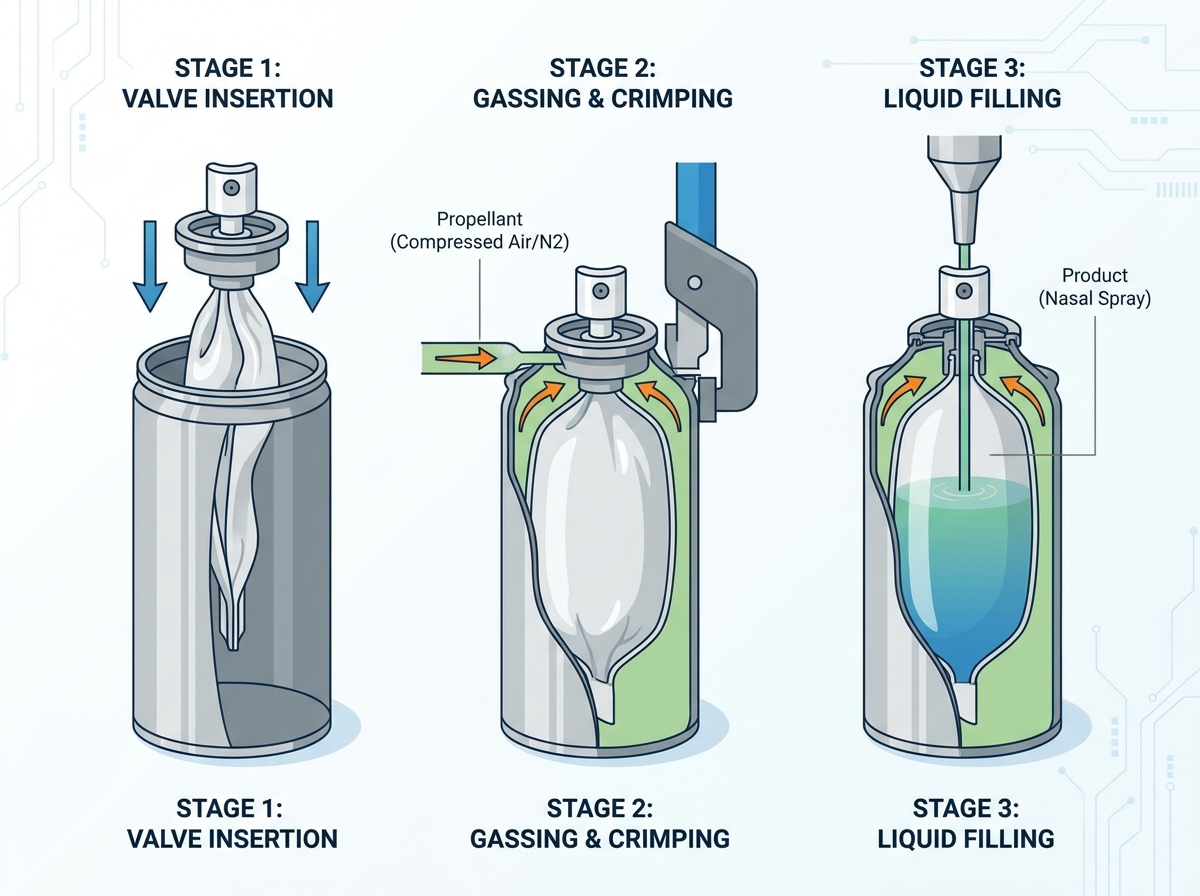
Understanding the mechanical workflow helps you optimize production. A standard BOV filling machine for nasal spray follows a precise four-phase sequence. Each phase requires exact timing and physical calibration.
Phase 1: Valve Insertion and Purging. The machine mechanically aligns the bag-on-valve unit. It inserts this assembly into an aluminum or tinplate can. Automated sorters ensure the valve sits perfectly straight.
Phase 2: Under-the-Cup Gassing & Crimping. The gassing head descends over the valve. It lifts the cup slightly. The machine injects the specified pressure of compressed air or nitrogen. It fills the space around the bag. The head then immediately performs a hermetic crimp. This permanently seals the valve to the can.
Phase 3: High-Pressure Liquid Filling. Liquid never touches the atmosphere. The machine forces the saline or medicated solution directly through the valve stem. High-pressure pumps drive the liquid into the internal bag. This process expands the bag against the surrounding compressed gas.
Phase 4: Weight and Pressure Verification. The machine moves the filled cans to a checking station. In-line mechanical sensors verify the fill volume. They also check internal pressure tolerances. Cans failing these checks face immediate rejection.
Best Practice: Always calibrate your crimping heads daily. Proper crimp depth prevents micro-leaks during the high-pressure liquid filling phase.
GMP Compliance and Cleanroom Hygiene Standards
Pharmaceutical manufacturing demands rigorous hygiene. You must evaluate equipment based on strict cleanroom compatibility. Material specifications play a foundational role here. You must mandate 316L stainless steel for all product-contact parts. This premium alloy resists corrosion from saline and aggressive sanitization chemicals. You should specify 304 stainless steel for general machine framing. It provides durability against frequent washdowns.
CIP/SIP integration determines your daily downtime. Clean-in-Place and Sterilize-in-Place protocols are essential. Evaluate the machine’s capacity to execute these cycles automatically. Modern systems flush internal lines without requiring total mechanical teardowns. This feature drastically reduces contamination risks between batches.
Contamination mitigation extends beyond internal piping. You must secure the external filling environment. Ensure your machine features enclosed filling zones. Verify its compatibility with HEPA filter integration. Drip-free nozzle designs are mandatory. They prevent liquid splashing and cross-contamination. These features help you maintain Class C or D cleanroom certifications.
Data integrity is a non-negotiable regulatory requirement. The FDA enforces CFR 21 Part 11 for electronic records. Your PLC software must support these pharmaceutical applications. It needs to log comprehensive audit trails. It must enforce unique operator logins. The system should automatically record any batch parameter deviations. Transparent data ensures smooth regulatory audits.
Quality Control Mechanisms and Automated Rejection
Nasal sprays deliver highly concentrated doses. Micro-dosing tolerances are incredibly strict. You must maintain acceptable variance margins. These margins typically sit at ±1% or better for low-volume formats. Piston pumps must deliver exact fluid measurements. Even minor volume deviations can impact patient safety.
In-line leak detection secures structural integrity. Crimping errors create microscopic escape paths for the propellant. You must implement leak detection post-crimping. Water bath testing machines immerse the cans in warm water. Rising bubbles easily identify pressure leaks. Alternatively, you can use micro-leak gas detection sensors. These sensors sniff the air around the valve for escaped nitrogen.
Automated rejection logic handles defective units. Modern PLCs monitor every sensor continuously. They identify under-filled or over-pressurized cans. They also spot uncrimped valves. The system physically diverts these bad cans from the primary line. It uses a pneumatic pusher to discard them. Crucially, it does this without stopping the machine. This keeps your overall production efficiency high.
Common Mistake: Relying solely on manual weight checks. Operators cannot match the speed and accuracy of in-line automated checkweighers.
Scalability: Semi-Automatic vs. Fully Automatic Equipment Lines
Your production volume dictates your equipment architecture. You must align your machine choice with your specific throughput goals. Understanding the structural differences helps you plan for future scaling.
Semi-automatic workstations serve distinct niches. They are ideal for R&D labs and clinical trials. They also handle low-volume specialized runs perfectly. These units require manual operator intervention. A technician moves the can between the gassing and liquid filling stations. You can expect a capacity of 10 to 15 cans per minute.
Fully automatic lines handle commercial production. You must choose between rotary and linear configurations. Linear machines move cans in a straight line. They are often easier for format changeovers. Rotary machines use star-wheels to move cans continuously. Engineers design them for high-speed output. Rotary lines easily achieve 50 to 100+ cans per minute.
Format changeover dynamics heavily influence daily efficiency. You will eventually switch between different can diameters or fill volumes. You must assess the tooling requirements carefully. Evaluate the realistic downtime required for these changes. Quick-release tooling serves as a key evaluation metric. It allows operators to swap parts without specialized wrenches.
Equipment Comparison Overview
System Type
Typical Capacity
Primary Use Case
Format Changeover Speed
Semi-Automatic
10-15 CPM
R&D, Clinical Trials
Fast (Manual Adjustments)
Linear Automatic
30-60 CPM
Mid-Volume Commercial
Moderate (Quick-Release Tools)
Rotary Automatic
50-100+ CPM
High-Volume Continuous
Slower (Requires Star-Wheel Swaps)
Implementation Risks and Facility Requirements
Deploying heavy machinery involves hidden technical challenges. You must prepare your physical facility before the machine arrives. Facility utility requirements often surprise new buyers. Gassing stations consume massive amounts of compressed air. You must evaluate your existing compressors. Upgrade them to meet the exact CFM (Cubic Feet per Minute) requirements of the new line. Insufficient air pressure causes inconsistent crimping.
Operator training demands significant attention. High-pressure liquid pumps require specific maintenance routines. Technicians face a steep learning curve. They must learn how to troubleshoot crimp-depth issues. Improper crimping leads to immediate batch failures. You should secure comprehensive training programs from your equipment vendor.
Shortlisting your vendor requires a methodical approach. You should request specific cycle-time guarantees in writing. Ask for verifiable reference cases within the healthcare sector. Demand a detailed FAT (Factory Acceptance Test) protocol. You must test the machine using your actual cans and valves. Do this before it ever leaves the vendor's facility. If you need assistance structuring a rigorous FAT protocol, feel free to contact us.
Conclusion
Investing in BOV technology transforms your medical spray operations. It fundamentally serves as a compliance and risk-management decision. It actively protects your product from environmental contamination.
Precision in the crimping and liquid filling stages dictates the final patient experience.
Strict adherence to GMP materials ensures long-term machine viability and audit success.
Automated in-line quality control prevents defective units from reaching consumers.
You must audit your current throughput needs accurately. Draft a strict User Requirement Specification (URS) immediately. Compare potential equipment vendors based on verifiable data and engineering support. Prioritize machine reliability and cleanroom compatibility above all other metrics.
FAQ
Q: What is the typical lead time for a fully automatic BOV filling line?
A: Manufacturers usually require 3 to 6 months to deliver a fully automatic line. This timeline heavily depends on the level of customization. Integrating specific cleanroom features or specialized CIP/SIP protocols extends the engineering phase. You should finalize your URS early to prevent manufacturing delays.
Q: Can a standard BOV machine handle high-viscosity nasal gels?
A: Standard piston pumps work perfectly for thin saline solutions. However, high-viscosity nasal gels require specialized equipment. You must equip the machine with positive displacement pumps. These specialized pumps force thicker gels through the narrow valve stem without causing cavitation or product shear.
Q: What is the acceptable pressure loss after crimping in a BOV process?
A: Zero pressure loss is the only acceptable standard. Even micro-leaks eventually ruin the dispensing performance. You must route all cans through a water bath testing machine post-crimping. This test physically verifies structural integrity and catches any microscopic pressure drops immediately.
Q: Do these machines require a dedicated cleanroom?
A: The machine itself can technically run in standard industrial environments. However, pharmaceutical regulations dictate the environmental grade. Manufacturing medical nasal sprays requires strict contamination control. Therefore, you must operate these machines within certified Class C or D cleanrooms to maintain regulatory compliance.