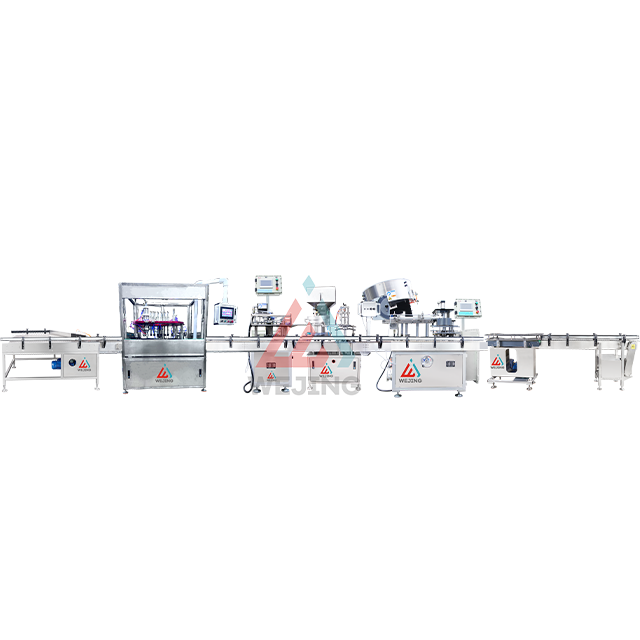
Aerosol products are widely used in personal care, household cleaning, automotive care, insecticides, and industrial coatings. Building an efficient and safe aerosol factory hinges on scientifically and rationally configuring production equipment. A complete aerosol production system is not a single machine but an integrated whole consisting of a fully automatic filling line, auxiliary inspection equipment, post-packaging systems, and utility facilities. This article systematically outlines the core equipment list and key configuration considerations for an aerosol factory.
1. Core Production Equipment
The aerosol filling line is the heart of the factory, with equipment arranged sequentially according to the process flow to complete the transformation from empty cans to finished products.
(1) Can Feeder: As the front-end of the line, the unscrambler automatically organizes randomly stacked empty cans into a uniform direction and feeds them orderly to the next station, ensuring continuity for subsequent filling operations.
(2) Aerosol Liquid Filling machine: This equipment fills the liquid components (such as solvents, active ingredients, fragrances, etc.) into the cans with precise metering. Depending on product characteristics, piston-type or flowmeter-type fillers can be selected.
(3) Valve Inserter: Places the aerosol valve accurately onto the can opening, preparing it for sealing.
(4) Crimping Machine: Mechanically compresses the valve and can opening to form a tight, reliable seal, preventing leakage of contents.
(5) Propellant Filling machine: Charges the propellant (e.g., propane/butane, DME, nitrogen, or compressed air) into the can through the valve under high pressure. Depending on the process layout, the propellant filler can be combined with the crimper or set up as separate units.
(6) (Optional) Shaker / Oscillator: For products containing powders or those that require further mixing, the oscillator vibrates the cans to ensure thorough homogenization of the contents.
(7) (Optional) Glass Bead Placing Machine: This machine dispenses glass beads into aerosol cans; glass beads are typically used in paint aerosols and snow spray aerosols. They help promote uniform mixing.
(8) Vacuum Machine: This is typically used in cartridge filling lines and is usually integrated with a sealing machine and a gas-filling machine.
2. Auxiliary and Inspection Equipment
To ensure the quality and safety of every can, the following key equipment is typically positioned downstream of the filling line:
(1) Checkweigher: Performs in line dynamic weighing of each finished can, automatically identifying and rejecting those with weight deviations, thereby controlling filling accuracy at source.
(2) Water Bath Leak Tester: Passes finished cans through a hot water bath, checking for leaks by observing bubbles or monitoring pressure changes—this is a core step in aerosol safety assurance.
(3) Water Bath Dryer: Dries the surface of cans after the water bath test with hot air, ensuring they are clean and dry for subsequent packaging.Water Bath Dryer are typically integrated with water bath testers.
(4) Internal Pressure Tester: In line inspection of can internal pressure to verify it is within the standard range, further enhancing product safety.
(5) Automatic Nozzle / Actuator Placer:Precisely installs the nozzle or actuator onto the valve.
(6) Automatic Overcap Placer: Automatically snaps the protective overcap onto the top of the can.
(7) Coding / Inkjet Printer: Prints production date, batch number, expiry date, and other information clearly on the can bottom or body, meeting traceability and regulatory requirements.
(8) Automatic Labeling/Tube Applicator:Automatically applies labels or instruction leaflets.
3. Post-Packaging Equipment
Packages the inspected finished products into their final shipping form:
(1) Case Erector: Automatically opens and forms folded cartons.
(2) Case Packer: Automatically loads cans into cartons according to preset quantities and arrangements.
(3) Case Sealer: Seals filled cartons with tape or hot-melt adhesive.
(4) Palletizer: Automatically stacks sealed cartons in a specified pattern onto pallets for storage and transport.
4. Utilities and Supporting Facilities
Systems that provide power and support for the entire production line:
(1) Compressed Air System: Supplies clean, stable power air for all pneumatic components and actuators along the line.
(2) Conveyor System: Connects individual machines to enable smooth, automatic transfer of cans between stations.
(3) Explosion Proof System: Because production involves flammable and explosive propellants, the entire line and its electrical controls must meet national explosion proof standards.
(4) Electrical Control System: Centered around a Programmable Logic Controller (PLC) to achieve automatic operation and real time monitoring of the entire line.
(5) Raw Material Storage and Transfer System: Used to centrally store liquid raw materials and propellants, and pump them via pipelines to the respective filling stations.
5. Configuration Options Reference
Equipment selection depends on product positioning and investment scale:
(1) Small to Medium or Semi Automatic Solution:
An integrated combination machine that combines liquid filling, crimping, and propellant filling in one unit is compact and flexible, typically operable by 1 2 staff.
(2) Medium to High Speed Fully Automatic Solution
A modular production line design, where each unit is configured as needed. For example, a standard medium high speed line may include a can unscrambler, multi head liquid filler, valve inserter, crimper, multi head propellant filler, etc. Such lines can achieve production speeds of 90 180 cans per minute or even higher, suitable for high volume production.
Conclusion
Configuring a reasonable and efficient aerosol production line requires comprehensive consideration of product type, capacity targets, automation level, safety regulations, and investment budget. The list above serves as a basic guide for project planning and equipment selection. It is recommended to engage in detailed discussions with professional equipment suppliers to obtain customised solutions before implementation.