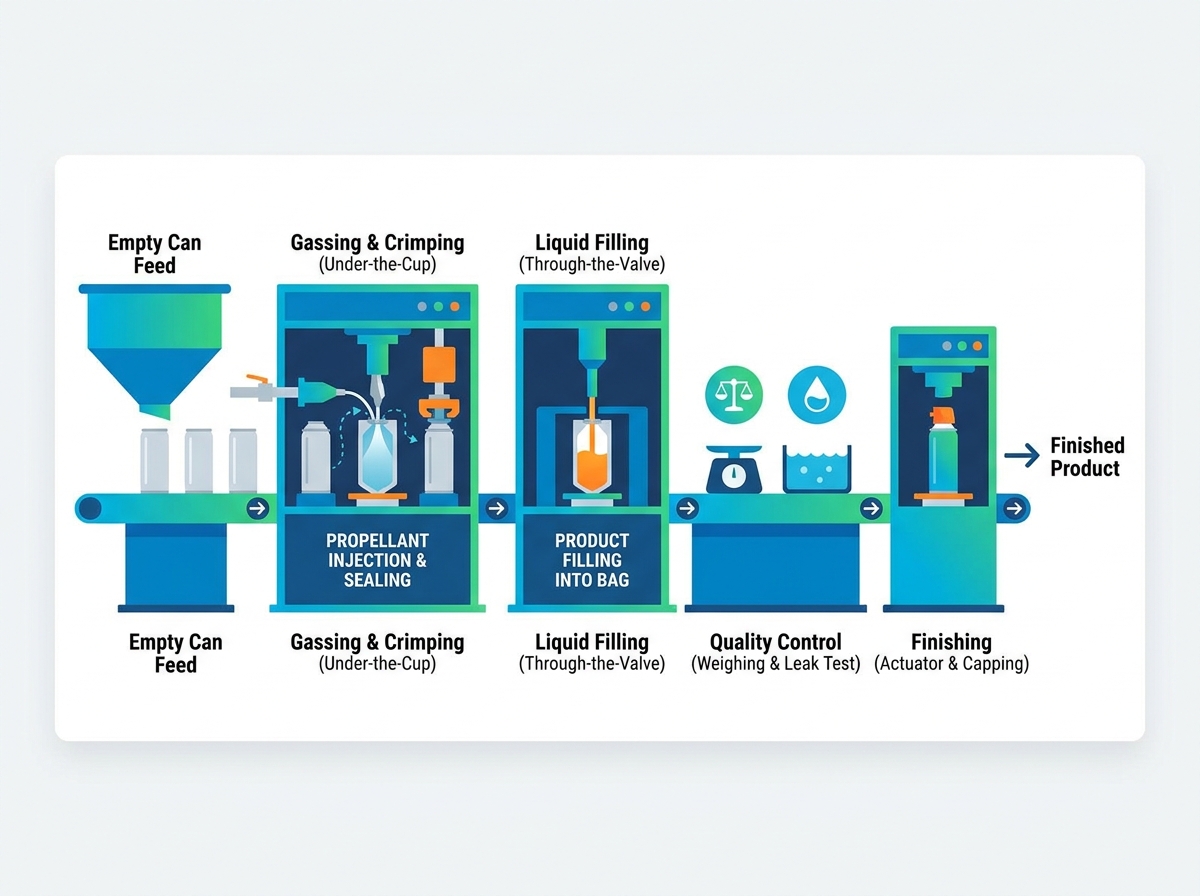
Transitioning from semi-manual processes to a continuous Bag-on-Valve (BOV) production line represents a major engineering leap. Operations managers, procurement heads, and production engineers face unique integration risks when scaling this specialized technology. Traditional aerosol packaging lines simply do not translate to BOV requirements. You need distinct equipment configurations. These carry high capital expenditure and require exact specifications to avoid costly production bottlenecks. Sourcing the right system is a high-stakes decision.
In this comprehensive guide, we map out the exact machine stations required for continuous production. You will learn strict evaluation criteria for selecting reliable equipment. We also explore the realities of factory implementation. By understanding these specific components, you can confidently build a highly efficient, automated facility. We define the evaluation steps necessary to secure the right machinery for your operational scale.
Key Takeaways
A complete BOV line separates propellant gassing and product filling into two distinct processes: under-the-cup gassing/crimping and through-the-valve liquid filling.
Upgrading to an automatic BOV filling machine shifts the production bottleneck from manual labor to machine changeover efficiency and material handling.
Evaluating vendors requires looking beyond theoretical output speeds (CPM) to verify material compatibility (e.g., aluminum vs. plastic) and compliance standards (ATEX/GMP).
Implementation success hinges on rigorous Factory Acceptance Testing (FAT) and establishing strict preventive maintenance protocols for crimp depth and seal integrity.
Core Station Mapping: Anatomy of a Complete BOV Filling Line
Understanding a continuous BOV line requires breaking down the sequential equipment. You must move empty containers to market-ready products seamlessly. Unlike standard aerosols, BOV technology separates the gas and liquid phases entirely. This demands highly specialized stations along your conveyor belt. Each node in the system must synchronize perfectly to maintain overall line speed.
Can Feeding and Cleaning Stations
The process begins before any product enters the container. You must ensure contaminant-free inputs. Rotary unscrambling tables automatically align bulk empty cans onto the conveyor. Manual sorting slows down the entire line. An automated unscrambler provides a continuous, paced feed.
Once aligned, cans pass through an air-rinse system. Static electricity often traps dust inside aluminum or plastic containers. The rinsing station blasts ionized air into each can. It vacuums out particulate matter immediately. Contaminants cause micro-leaks in the delicate BOV bag. Skipping this cleaning step compromises your final product quality. We recommend integrating a vision system here. It rejects dented or defective cans early.
The Gassing and Crimping Station (Under-the-Cup)
This station acts as the critical differentiator in BOV manufacturing. Standard aerosols mix propellant and liquid. BOV injects compressed air or nitrogen into the can before sealing. The machine lifts the valve cup slightly. It forces the inert gas underneath the cup and into the can body. Once the target pressure is reached, the crimping head seals the valve.
Your primary evaluation node here is precision. The vacuum seal must be flawless. Crimp depth accuracy directly prevents propellant leakage. If the crimp is too tight, it damages the valve mechanism. If it is too loose, the gas escapes over time. Precise servo-driven crimping heads offer better control than pneumatic alternatives. Monitor the gas pressure gauges closely. They dictate the dispensing performance of the final product.
Liquid Filling Station (Through-the-Valve)
After crimping, the can contains a pressurized environment surrounding an empty bag. The liquid filling station forces the active product into this internal bag. It operates under extremely high pressure. The machine opens the valve stem and pumps the liquid down through it. This expands the bag inside the pressurized can.
Volumetric accuracy is your critical evaluation node. Highly viscous liquids like gels, heavy creams, or adhesives present unique challenges. They require robust positive displacement pumps. You must also evaluate the anti-drip nozzle technology. Viscous products tend to string or drip. A high-quality anti-drip nozzle shears the product cleanly. This prevents contamination on the valve cup. Product residue on the valve complicates the actuator placement later.
Quality Control: Weighing and Water Bath Testing
Quality control cannot be a manual afterthought. It must happen inline. Continuous checkweighers measure every single can. They verify the exact product volume inside the bag. Under-filled cans shortchange the consumer. Over-filled cans risk bursting the internal bag. The checkweigher automatically kicks out any can falling outside your strict weight tolerances.
Water bath leak detectors are another strict compliance requirement. Every pressurized can submerges in a heated water bath. The heat expands the internal gas. This forces bubbles out of any micro-leaks in the crimp or valve. Cameras or sensors monitor the bath. They identify and reject leaking containers automatically. This station protects your brand from dangerous recalls and shelf-life failures.
Finishing: Actuator, Cap Pressing, and Coding
The finishing stations prepare the functional product for retail. Vibratory bowls sort the actuators and overcaps. They feed them into the pressing station. Automatic arms or star-wheels align the actuator over the valve stem. The machine presses it down gently to avoid accidental dispensing. Next, the overcap snaps securely into place.
Integration with batch coders finalizes the unit. Inkjet or laser coders print manufacturing dates and lot numbers on the can bottom or cap. Traceability is non-negotiable in pharmaceutical and cosmetic industries. High-speed laser coders provide permanent marks. They eliminate ink consumable costs. Synchronize your coders directly with your central control system for accurate batch tracking.
The Business Case for an Automatic BOV Filling Machine
Framing the transition from semi-automatic to fully automatic systems requires looking at ROI and risk mitigation. Sourcing a reliable automatic BOV filling machine shifts the production bottleneck. It moves the focus from manual labor speed to machine changeover efficiency. This transition fundamentally changes how your facility operates.
Yield and Waste Reduction Continuous rotary or high-speed indexing machines minimize product giveaway. Semi-automatic machines rely on operator timing. This causes inconsistent gas levels and liquid volumes. Automated systems use servo-driven volumetric pistons. They dose exact amounts every cycle. Furthermore, they control gas loss perfectly. Wasted propellant and spilled liquid erode your profit margins quickly. Automation tightens these tolerances.
Labor Reallocation Manual BOV operation demands immense physical repetition. It exposes operators to fatigue and error. Fully automated lines shift workforce requirements. You no longer need operators to move cans between stations. Instead, you need technicians and quality control supervisors. You upskill your workforce. They focus on preventive maintenance, data analysis, and process optimization. This drastically reduces ergonomic injuries and turnover.
Throughput Scalability Manufacturer claims of "maximum CPM" (Cans Per Minute) often mislead buyers. You must calculate true OEE (Overall Equipment Effectiveness). A machine rated for 60 CPM in a lab will not hit that in reality. Changeovers, minor jams, and material loading cause downtime. An automated system provides predictable scalability. You can track OEE metrics through the machine interface. This data allows you to optimize your supply chain scheduling.
Operational Metrics Comparison
Production Metric
Semi-Automatic Process
Fully Automated Process
Yield Consistency
High variance between operator shifts
Strict volumetric and pressure control
Labor Utilization
Manual transfer and manual loading
Supervisory, quality, and maintenance
Gas Loss Rate
Moderate to high depending on operator
Near zero with sealed automated crimping
OEE Tracking
Manual logging and estimation
Integrated PLC data logging and reporting
Material Flexibility: Handling Aluminum Cans vs. Plastic Bottles
Modern production facilities require agility. Addressing container material flexibility solves a common engineering challenge. It also reveals a major vendor evaluation blind spot. Buyers often assume a machine handles any container. This is a costly mistake. Handling rigid aluminum cans differs vastly from handling PET or plastic bottles.
How change parts differ is crucial. Rigid aluminum cans withstand aggressive handling. Metal star-wheels and tight guide rails guide them easily. Plastic containers scratch and dent. Switching between them requires specific tooling. You need gentle-handling polymer guide rails for plastic. You also need different pucks or carrier systems. Pucks hold lightweight plastic bottles steady during the high-pressure filling process.
Pressure sensitivities dictate your gassing approach. Under-the-cup gassing pressure must adjust precisely. High pressure inflates the aluminum can without issue. However, that same pressure will deform a plastic container. The base of a PET bottle can round out. It may fail to stand flat on the shelf. You must calibrate the gas injection speed and final pressure limits carefully for plastic.
Demand that vendors demonstrate rapid adjustments. Multi-material facilities die by slow changeovers. Use this shortlisting logic when speaking to manufacturers:
Assess the structural integrity limits of your chosen containers.
Review the vendor's quick-change tooling designs (demand tool-less adjustments).
Test gas pressure limits on actual plastic samples during initial vendor meetings.
Verify the machine saves distinct recipes for different materials in the control panel.
Vendor Evaluation Matrix: How to Shortlist BOV Equipment
Arming yourself with a skeptical, evidence-based evaluation framework prevents poor purchasing decisions. Not all machines perform equally under stress. You must interrogate the vendor's engineering standards. Look past the polished sales brochures.
Compliance and Safety Standards
Regulatory compliance is your absolute baseline. Verify CE markings for European standards. Investigate ATEX certifications. BOV typically uses inert gases like nitrogen or compressed air. However, your liquid product might be highly flammable. If you fill alcohol-based cosmetics or solvent-heavy industrial sprays, your entire line needs explosion-proof ATEX ratings. Furthermore, pharmaceutical and personal care lines demand GMP (Good Manufacturing Practice) certifications. Ensure the vendor uses 316L stainless steel for all product-contact parts. Sanitary welds and easy-clean designs are non-negotiable.
Control Systems and Data Integration
The brain of your machine dictates your operational success. Evaluate the PLC (Programmable Logic Controller) brand carefully. Avoid proprietary or obscure systems. Insist on globally supported brands like Siemens or Allen-Bradley. If a controller fails, you need local technicians who understand the code. Review the HMI (Human-Machine Interface) screens. They must be intuitive. Assess the data logging capabilities. Your line must record batch traceability, pressure readings, and checkweigher rejections. Quality auditing relies on this automated data capture.
Customization vs. Off-the-Shelf Limitations
Off-the-shelf machines rarely fit complex product portfolios perfectly. Assess the vendor's true engineering capability. Do they outsource their design work? You might use unique bag shapes for dual-compartment dispensing. You might pump highly viscous formulas that clog standard valves. You might have severe footprint constraints in your facility. A capable vendor modifies the equipment layout. They design custom anti-drip nozzles. They build U-shaped conveyor lines to fit tight floor spaces. Probe their willingness to customize critical components.
Implementation Realities and Maintenance Risks
Demonstrating trustworthiness means highlighting what actually goes wrong after the purchase. Equipment looks flawless in the showroom. The factory floor presents a harsh reality. Understanding these implementation risks ensures a smoother launch.
Run specific materials: You must supply your exact cans, valves, bags, and bulk liquid.
Test continuous speeds: Do not accept brief one-minute runs. Demand a continuous hour of production.
Simulate changeovers: Force the vendor to switch out tooling during the test. Time the process.
Check documentation: Verify the operational manuals match the customized machine perfectly.
The FAT (Factory Acceptance Test) standard prevents disasters. Why must you run your specific materials? Viscosity changes under pressure. Your specific gel might foam unpredictably. Your specific cans might jam the star-wheels. Identifying these issues at the vendor's facility costs nothing. Discovering them on your floor costs weeks of downtime.
Address common failure points proactively. Seal integrity drifts over time. It is an unavoidable mechanical reality. The crimping jaws wear down. You face the necessity of routine crimp-gauge calibrations. Operators must measure crimp depth and diameter every single shift. Do not assume the machine holds its setting indefinitely.
Evaluate spare parts and support agreements strictly. Ask for the SLA (Service Level Agreement) for technical support. Machines fail during peak seasons. You need guaranteed response times. Local availability of critical wear parts is vital. O-rings, filling seals, and crimper collets degrade. Keep a robust inventory of these parts on your own shelf. Waiting two weeks for an imported seal shuts down your business.
Conclusion
A complete BOV line functions as a highly integrated ecosystem. Precision at the under-the-cup gassing and crimping stage dictates the ultimate success of your final product. You cannot afford weak links in material handling, liquid filling, or quality control. Upgrading this technology requires diligent planning and strict vendor accountability.
Your next steps must be intensely practical. Document your exact product viscosities, container dimensions, and target output rates. Require prospective vendors to provide output calculations based on your specific OEE targets. Do not accept ideal-state lab tests as reality. Plan your FAT rigorously. For personalized support during your facility upgrade, you can always contact us to discuss specific equipment configurations.
FAQ
Q: What is the standard footprint for a fully automatic BOV filling line?
A: A linear automatic setup typically requires a space of roughly 10 to 15 meters in length and 2 to 3 meters in width. Rotary configurations condense the footprint significantly, often requiring a compact 4 by 4 meter square. Always account for additional space needed for accumulation tables, operator walkways, and bulk material staging.
Q: Can a standard aerosol filling machine be converted to BOV?
A: It is generally not recommended. Standard machines use through-the-valve gassing. BOV requires precise under-the-cup gassing before the crimp. The mechanical architecture is fundamentally different. While retrofitting is technically possible, conversion costs run exceptionally high. Buying purpose-built BOV machinery ensures seal integrity and avoids continuous maintenance failures.
Q: What is the typical lead time for manufacturing and commissioning an automatic line?
A: You should set realistic expectations of 3 to 6 months. Standard machines fall on the shorter end of this spectrum. Highly customized lines requiring specific footprint adjustments or specialized viscous fluid pumps take up to 6 months. Commissioning and FAT add another two to four weeks to the timeline.
Q: Does BOV require explosion-proof (ATEX) equipment?
A: BOV inherently uses inert gases like nitrogen or compressed air, reducing propellant flammability risks. However, facility requirements depend entirely on your liquid product. If your product contains alcohols, solvents, or flammable active ingredients, your entire filling line and facility room must meet strict ATEX explosion-proof standards.