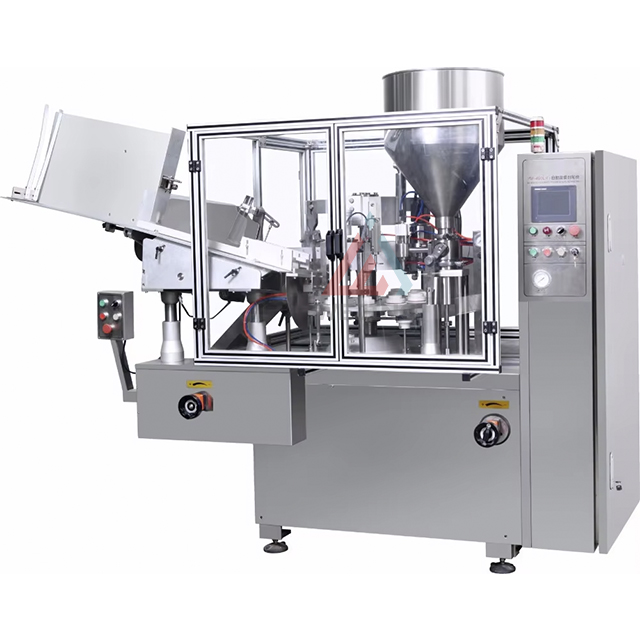
Tube filling is a crucial process in packaging various products we use daily. From cosmetics to pharmaceuticals, it ensures precise and hygienic product delivery.
In this blog, we'll explore the ins and outs of tube filling. You'll learn about different machines, techniques, and industries that rely on this essential packaging method.
Types of Tubes for Filling
When it comes to tube filling,the frist thing you should know is tyoes of tubes for filling. There are three main types available to suit various products and industries: plastic tubes, laminated tubes, and aluminum tubes.
Plastic Tubes
Plastic tubes are popular because of their excellent moldability and economic efficiency. Often made from materials such as polyethylene (PE), polypropylene (PP) or polyethylene terephthalate (PET), these hoses are lightweight, pressure-resistant and impact-resistant. Its unique elastic memory allows it to quickly return to its original shape after extrusion, making it ideal for frequently used products.
Plastic tubes are widely used in the cosmetic, personal care and food industries, and are especially suitable for lighter-textured products such as lotions, cleansers and hand creams.
Laminated Tubes
Advances in Laminated Tube technology have led to more advanced packaging solutions. There are two types of laminated tubes: aluminum barrier laminate (ABL) tubes and plastic barrier laminate (PBL) tubes.
Aluminum Barrier Laminate (ABL) Tubes
Aluminum Barrier Laminate (ABL) tubing combines the flexibility of plastic with the superior barrier properties of aluminum, and is typically composed of multiple layers, including an inner PE layer, an intermediate aluminum foil layer, and an outer PE or PET layer, which effectively blocks oxygen, light, and moisture and extends the shelf life of the product, making it particularly suited for products that are sensitive to oxidation, such as Vitamin C Extracts or certain medicated ointments.
Plastic Barrier Laminate (PBL) Tubes
Plastic Barrier Laminate (PBL) tubing, on the other hand, consists entirely of multiple layers of plastic, such as the PE/EVOH/PE structure, which provides better flexibility and recyclability while maintaining a certain level of barrier properties.PBL tubing is often used for products that require a medium level of barrier properties, such as toothpaste or hair conditioner.
Understanding Different Types of Tube Filling Machines
Tube filling machines fill semi-fluid or viscous liquids into all types of tubes at a precise volume and speed. From personal care products to pharmaceutical preparations, tube-filling machines play an integral role in a variety of industries and can handle a wide range of materials from low-viscosity aqueous emulsions (e.g., shampoos with a viscosity of around 5,000-10,000 cps) to high-viscosity ointments (e.g. medicinal ointments with a viscosity of more than 100,000 cps).
According to the degree of automation and production needs, tube filling machine is mainly divided into three types: manual tube filling machine, semi-automatic tube filling machine and fully automatic tube filling machine.
Manual Tube Filling Machine
Definition:
A manual tube filling machine is the most basic filling equipment, using human operation with the simple mechanical structure to complete the filling process. These machines usually use a piston or pneumatic filling system, and the filling accuracy can reach ±1-2%.
Features
Flexible operation, suitable for small quantities and varieties of production
Simple structure, low maintenance costs, low initial investment
Filling speed is slow, usually 10-30 tubes/minute
Suitable for small production lines or laboratories with low output requirements
Application
Application scenarios include small cosmetic studios, pharmacy custom formulations, or laboratory sample preparation. However, due to the high human influence, ensuring long-term filling consistency with this type of equipment is difficult.
Semi-automatic Tube Filling Machine
Definition
Combining manual operation and mechanical automation, semi-automatic tube filling machines represent an ideal choice for medium-sized production. These machines typically utilize a servo motor-driven dosing pump system, and filling accuracy can be improved to ±0.5-1%.
Features:
Automation of the filling process, but manual loading and unloading is required
Significantly higher filling speeds, up to 30-60 tubes/minute
Equipped with precision dosing systems, such as gear pumps or peristaltic pumps
Adjustable parameters to suit different tube sizes (15-50mm diameter) and product viscosities (1000-50,000 cps).
Application
These machines are commonly found in small and medium-sized cosmetic production lines, pharmaceutical manufacturers and food and flavorings manufacturers. They are usually equipped with a PLC control system for simple production data recording and parameter adjustment.
Fully Automatic Tube Filling Machine
Definition
Fully automatic tube-filling machines represent the highest level of tube-filling technology and are suitable for large-scale industrial production. These machines integrate advanced mechatronics technology, realizing full automation from tube loading, positioning, filling, and sealing to batch number printing.
Features
High production efficiency, up to 100-300 tubes/minute
Filling accuracy up to ±0.2-0.5%, relying on high-precision servo system and advanced flow control technology
Integration of advanced PLC or industrial PC control systems to support complex production recipe management and data traceability.
Compatible with a wide range of filling systems, such as time-pressure, volumetric or mass flow meter, to accommodate products with different viscosities (1-500,000 cps) and characteristics.
Seamless integration with other automation equipment (e.g. cartoning and labeling machines) to form a complete production line.
Application
These machines are widely used by large cosmetic companies, pharmaceutical manufacturers for high-speed production lines and industrial batch production. Many fully automated systems also integrate in-line quality inspection (e.g. metal detection, weight check), intelligent IoT connectivity and environmentally friendly, energy-efficient designs (e.g. servo-driven systems with 30-50% lower energy consumption).
Key Components and Working Principles of a Tube Filling Machine
Product Feeding System
Hopper or Tank: Typically made of 316L stainless steel, capacity ranging from 50 to 500 liters.
Agitator: Ensures product homogeneity, with speeds adjustable from 20 to 200 RPM.
Temperature Control: Maintains product at optimal viscosity, precise to ±0.5°C.
Pumping and Metering System
Positive Displacement Pump: Usually a servo-driven piston or rotary lobe pump.
Accuracy: Capable of ±0.5% by weight or volume.
Flow Rates: Adjustable from 1 ml/min to 1000 ml/min, depending on product viscosity.
Viscosity Range: Can handle products from 1 cPs to 1,000,000 cPs.
Filling Nozzle Assembly
Material: 316L stainless steel or FDA-approved polymers.
Anti-drip Mechanism: Employs a pneumatic or servo-driven cut-off valve.
Nozzle Diameter: Interchangeable, ranging from 2mm to 25mm.
Fill-from-Bottom Technology: Reduces air entrapment, crucial for products sensitive to oxidation.
Tube Handling System
Feeding Mechanism: Utilizes vibratory bowl feeders or magazine loaders.
Positioning Accuracy: ±0.1mm, ensured by servo-controlled grippers.
Tube Sizes: Accommodates diameters from 10mm to 50mm and lengths from 50mm to 250mm.
Sealing Mechanism
Heat Sealing: For plastic tubes, temperature controlled to ±1°C.
Crimp Sealing: For metal tubes, with adjustable crimp patterns.
Ultrasonic Sealing: For laminated tubes, operating at frequencies of 20-40 kHz.
Seal Integrity: Typically tested to withstand pressures up to 3 bar.
Control System
PLC: Allen-Bradley or Siemens, with cycle times as low as 1ms.
HMI: Touchscreen interface, typically 10-15 inch, with recipe management capabilities.
Data Logging: Records critical parameters like fill weight, seal temperature, and cycle times.
Connectivity: Supports Industry 4.0 protocols like OPC-UA or MQTT
Working Principle of Tube Filling Machine
Tube Feeding: Empty tubes are fed into the machine, oriented correctly, and positioned under the filling nozzle.
Product Preparation: The product is homogenized in the hopper and pumped to the filling station, maintaining optimal temperature and viscosity.
Filling Operation: The nozzle descends into the tube, and the metering pump dispenses the precise amount of product. Fill-from-bottom technology may be employed to reduce air entrapment.
Tube Sealing: After filling, the tube is transferred to the sealing station where it is sealed using the appropriate method (heat, crimp, or ultrasonic).
Quality Control: Filled and sealed tubes undergo weight checking (±0.1g accuracy) and vision inspection for seal integrity and fill level.
Coding and Marking: Batch numbers and expiry dates are printed, typically using laser or inkjet technology with a resolution up to 600 DPI.
Output: Finished tubes are discharged onto a conveyor for secondary packaging.
How to Choose a Suitable Tube Filling Machine
Choosing the right filling machine for tubular containers is a complex decision-making process that requires a number of factors to be considered to ensure that the equipment is able to meet specific production requirements and quality standards. Typically, the following aspects need to be considered:
Product characterization:
The rheological properties of the product to be filled need to be analyzed in depth first. For Newtonian fluids, conventional volumetric filling systems can be used, while for non-Newtonian fluids (e.g., shear-thinning or shear-thickening types), advanced filling systems with shear rate compensation, such as servo-driven positive displacement pumps, need to be considered. At the same time, the viscosity range of the product (from 1 cPs to 1,000,000 cPs) will have a direct impact on the choice of pumping system.
Consider production size and flexibility:
Select the appropriate level of automation based on expected production volume. For low-volume, multi-variety production, a semi-automated system (30-60 tubes/minute) may be more cost-effective; for large-scale production, a fully automated system (100-300 tubes/minute) is more appropriate. At the same time, consider the rapid changeover capability of the equipment, such as the use of servo-driven regulating systems, which can realize the rapid changeover of different sizes of tubes (diameter 10-50mm, length 50-250mm).
Measuring accuracy requirements:
Different industries have different requirements for filling accuracy. For example, the pharmaceutical industry may require ± 0.5% high precision, while the cosmetics industry may be ± 1% is sufficient. Advanced metering technologies such as mass flow meters or servo-driven piston pumps should be considered when selecting and combined with an on-line weight checking system (accuracy up to ±0.1g) to ensure consistency.
Understand tube body material compatibility:
Select the appropriate sealing technology based on the type of tube body used (plastic, metal or composite). For example, plastic tubes are suitable for heat sealing (temperature control accuracy ±1°C), metal tubes require crimp sealing, while composite tubes may require ultrasonic sealing (20-40 kHz). Equipment should be flexible enough to accommodate different sealing requirements.
Cleaning and hygiene standards:
For the pharmaceutical or food industry, cGMP-compliant equipment with 316L stainless steel construction with CIP (clean-in-place) and SIP (sterilized-in-place) capabilities is required. Filling systems should be designed with no dead space and consider using EHEDG certified components to ensure the highest standards of hygiene.
Intelligence and data management:
Modern filling equipment should have an advanced control system, such as an Allen-Bradley or Siemens PLC, with a 10-15-inch touchscreen HMI to support recipe management and data logging. At the same time, the equipment should support Industry 4.0 protocols such as OPC-UA or MQTT to achieve seamless integration with MES systems for production monitoring and traceability.
Environmental factors and energy efficiency:
Choose equipment with energy-efficient designs, such as servo drive systems that can reduce energy consumption by 30-50%. Also consider the equipment's noise level, footprint, and environmental control requirements (e.g., temperature and humidity control).
Validation and Compliance:
For regulated industries, equipment should meet relevant regulatory requirements, such as FDA 21 CFR Part 11 compliance. Consider whether the vendor can provide comprehensive IQ/OQ/PQ documentation support to streamline the validation process.
Total Cost of Ownership (TCO):
In addition to the initial investment, evaluate long-term operating costs, including energy consumption, maintenance requirements, and spare parts availability. Selecting equipment with remote diagnostic capabilities and predictive maintenance can significantly reduce downtime and maintenance costs.
Conclusion
In this ultimate guide to tube filling machines, we've covered different types of tube filling machines and their features. Also, some key factors to consider are listed for reference.
Choosing the best tube filling machine is crucial for your business's success. Don't hesitate to seek professional advice when making this important decision. Ready to take your tube packaging to the next level? Contact WEJING today for expert guidance and top-notch tube filling solutions!


