Introduction
Packaging plays a vital role in industries like pharmaceuticals, cosmetics, and food. But how do you ensure that your products stay secure and fresh? Tube filling and sealing machines offer a reliable solution, but ultrasonic tube sealing machines are gaining attention for their unique advantages.
In this article, we will explore the differences between traditional tube filling and sealing machines and ultrasonic tube sealing machines. You’ll learn how each technology works, their benefits and limitations, and how to choose the right one for your production needs.
How Tube Filling and Sealing Machines Work
Working Principle of Tube Filling and Sealing Machines
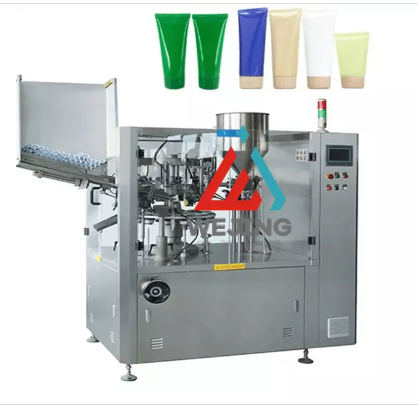
Traditional tube filling and sealing machines rely on a heat sealing process. An empty tube is placed under the filling nozzle, and a precise dose of product is dispensed into the tube. After filling, the tube moves to the sealing station, where heat and pressure are applied to the open end, closing the tube securely. The heat is applied to soften the tube material, allowing the sealing jaws to press and form a strong seal.
These machines are suitable for various tube materials, such as plastic, laminate, and aluminum. The heat sealing process works well for most products, and proper calibration ensures a reliable seal.
Applications of Tube Filling and Sealing Machines
Tube filling and sealing machines are widely used across multiple industries. In the pharmaceutical sector, they ensure medications are securely packaged, maintaining sterility. In cosmetics, the machines fill and seal tubes of creams, lotions, and gels, guaranteeing that products remain intact. The food industry also benefits from these machines, particularly for packing sauces, pastes, and condiments.
These machines are also indispensable in personal care products like toothpaste, hand creams, and sunscreens. Their ability to handle various product types and materials makes them highly versatile.
Advantages of Using Tube Filling and Sealing Machines
Material Flexibility: These machines can accommodate various materials such as plastic, laminate, and aluminum, offering a high degree of versatility.
Ease of Operation: With intuitive controls, including touchscreen interfaces, tube filling and sealing machines are easy to operate. Training is typically minimal, making them ideal for businesses with limited technical expertise.
Scalability: Tube filling and sealing systems come in semi-automatic, fully automatic, and high-speed variants. Companies can start with a semi-automatic machine and later scale up to fully automated or high-speed machines as production needs grow.
Challenges of Tube Filling and Sealing Machines
Temperature Sensitivity: Heat sealing can affect sensitive products, such as certain cosmetic creams or pharmaceuticals, which may degrade when exposed to high temperatures during the sealing process.
Inconsistent Seals: While generally reliable, traditional tube sealing machines sometimes require fine-tuning for optimal performance, especially with certain materials.
How Ultrasonic Tube Sealing Machines Work
Working Principle of Ultrasonic Tube Sealing Machines
Ultrasonic tube sealing machines use high-frequency ultrasonic vibrations to generate localized heat within the tube’s material. The vibrations cause friction between the layers of the tube, melting the material at the point of contact and forming a strong, airtight seal. Unlike heat sealing, which applies external heat, ultrasonic sealing is more energy-efficient and produces faster results with minimal heat impact on the product inside.
This method ensures that the product inside the tube is not exposed to the high temperatures often associated with traditional heat sealing processes, making ultrasonic machines ideal for products that are sensitive to heat.
Applications of Ultrasonic Tube Sealing Machines
Ultrasonic sealing is particularly well-suited for industries that require precise packaging with minimal heat exposure. In cosmetics, this technology is used to package high-end products like facial creams, eye serums, and lotions. These products are often sensitive to temperature changes, and ultrasonic sealing helps maintain their integrity by minimizing heat impact.
In pharmaceuticals, ultrasonic tube sealing machines are valued for creating tamper-proof seals that ensure the sterility of medications. This technology is also commonly used in organic and premium products where maintaining the product’s quality is essential.
Advantages of Ultrasonic Tube Sealing Machines
High Efficiency: The ultrasonic sealing process is extremely fast, typically sealing a tube in under a second. This speed helps increase overall production efficiency.
Low Heat Impact: Since ultrasonic sealing produces heat only where it’s needed, it avoids heating the product inside the tube, which is essential for preserving heat-sensitive formulations.
Precise Sealing: Ultrasonic machines provide a clean, strong seal with minimal defects, which is particularly valuable for industries where packaging aesthetics and product quality are paramount.
Challenges of Ultrasonic Tube Sealing Machines
Material Compatibility: Ultrasonic sealing machines are best suited for thermoplastic materials, such as LDPE, HDPE, and laminated plastics. They do not work well with aluminum tubes, which may limit their applications in certain industries.
Higher Initial Cost: Ultrasonic machines generally have a higher upfront cost compared to traditional tube sealing systems. However, this cost may be offset by the machine's energy efficiency and faster production speeds.
Key Differences Between Tube Filling and Sealing vs Ultrasonic Sealing
| Feature | Tube Filling and Sealing Machine | Ultrasonic Tube Sealing Machine |
| Sealing Strength | Reliable, with well-calibrated settings | High-quality, strong seal with minimal defects |
| Speed | Slower due to preheating and cooling | Faster, no preheating or cooling required |
| Suitability for Heat-Sensitive Products | May degrade heat-sensitive products | Ideal for temperature-sensitive products |
| Seal Quality | Can be inconsistent, especially with certain materials | Clean, precise, and uniform seals |
Sealing Performance: Comparing Strength and Quality
Tube Filling and Sealing Machines: These machines reliably provide a strong seal, but they may struggle with consistency when working with certain materials or if the settings are not well-tuned.
Ultrasonic Tube Sealing Machines: Ultrasonic sealing offers consistent, high-quality seals, making them ideal for precision packaging and sensitive products.
Material Compatibility: Which Materials Work Best?
Tube Filling and Sealing Machines: These machines can handle a wide range of materials, including plastic, laminate, and aluminum tubes.
Ultrasonic Tube Sealing Machines: Best suited for thermoplastic materials like LDPE and HDPE. They are not compatible with aluminum tubes.
| Material Type | Tube Filling and Sealing Machine | Ultrasonic Tube Sealing Machine |
| Plastic | Compatible | Compatible (LDPE, HDPE) |
| Laminate | Compatible | Compatible (Laminated plastics) |
| Aluminum | Compatible | Not Compatible |
Speed and Efficiency: Which Machine is Faster?
Tube Filling and Sealing Machines: These machines are slower due to the need for preheating and cooling cycles, though modern machines have optimized these processes for faster output.
Ultrasonic Tube Sealing Machines: These machines are much faster since they don't require preheating or cooling. The entire sealing process takes less than a second.
Maintenance Costs: Long-Term Considerations
Tube Filling and Sealing Machines: Traditional machines require regular maintenance, including the replacement of seals and heating elements. These ongoing costs can accumulate over time.
Ultrasonic Tube Sealing Machines: While the initial cost is higher, ultrasonic machines are more energy-efficient and require less maintenance, providing better long-term value.
Choosing the Right Tube Sealing Machine for Your Needs
| Feature | Tube Filling and Sealing Machine | Ultrasonic Tube Sealing Machine |
| Advantages | - Versatile, handles various materials | - Fast sealing, minimal heat impact |
| - Easy to operate with minimal training | - High-quality, strong seals |
| - Scalable for different production volumes | - Energy-efficient, faster production |
| Disadvantages | - Can struggle with heat-sensitive products | - Higher initial cost |
| - Can result in weak or inconsistent seals | - Limited to thermoplastic materials |
How to Match Machine Selection with Production Requirements
When selecting between a tube filling and sealing machine and an ultrasonic tube sealing machine, several factors must be considered:
Product Type: For heat-sensitive products, ultrasonic machines are a better choice due to their minimal heat exposure.
Production Volume: Ultrasonic machines are better suited for high-volume, fast-paced production lines, while traditional machines may be sufficient for smaller volumes.
Tube Material: If your production involves various materials, including aluminum, a traditional tube filling and sealing machine may be the best option due to its material compatibility.
Cost vs Benefits: What’s the Best Investment?
Tube Filling and Sealing Machines: These machines come at a lower upfront cost, making them ideal for businesses with limited budgets. They offer a good balance of performance for most general-purpose applications.
Ultrasonic Tube Sealing Machines: Although the initial investment is higher, ultrasonic machines provide faster production speeds and lower long-term maintenance costs, offering a better ROI for high-volume production lines.
What Does the Future Hold for Tube Sealing Technology?
The future of tube sealing technology holds promise for both traditional and ultrasonic machines. Ultrasonic machines may evolve to accommodate more materials, including metals, and offer even faster sealing times. Meanwhile, traditional machines may continue to improve in terms of energy efficiency and sealing precision.
Conclusion
Both tube filling and sealing machines and ultrasonic tube sealing machines offer distinct benefits depending on your needs. Traditional machines are cost-effective and versatile for various tube materials. Ultrasonic machines offer faster speeds, superior seal quality, and minimal heat exposure, making them ideal for heat-sensitive products and precise packaging.
By evaluating your product needs, production volume, and budget, you can make an informed decision about the best machine for your production line.
For advanced tube sealing solutions, consider Guangzhou Wejing Intelligent Equipment Co., Ltd.. Their innovative machines provide excellent value, enhancing packaging efficiency and quality.
FAQ
Q: What is the difference between a Tube Filling and Sealing Machine and an Ultrasonic Tube Sealing Machine?
A: A Tube Filling and Sealing Machine uses heat to seal tubes, while an Ultrasonic Tube Sealing Machine uses high-frequency vibrations to generate heat within the material for sealing. The ultrasonic machine is faster and ideal for heat-sensitive products.
Q: How does a Tube Filling and Sealing Machine work?
A: A Tube Filling and Sealing Machine dispenses product into a tube and then seals the open end using heat and pressure. It works well for various tube materials, including plastic, laminate, and aluminum.
Q: Why should I choose an Ultrasonic Tube Sealing Machine over a traditional one?
A: Ultrasonic machines provide faster sealing, higher quality, and minimal heat exposure, making them perfect for temperature-sensitive products like cosmetics and pharmaceuticals.
Q: How much does a Tube Filling and Sealing Machine cost?
A: The cost of a Tube Filling and Sealing Machine varies based on its size, features, and automation level, but it generally offers a more affordable upfront investment compared to ultrasonic models.
Q: What are the advantages of using a Tube Filling and Sealing Machine?
A: Tube Filling and Sealing Machines are versatile, easy to operate, and cost-effective. They are suitable for various product types and offer scalability for growing production volumes.


