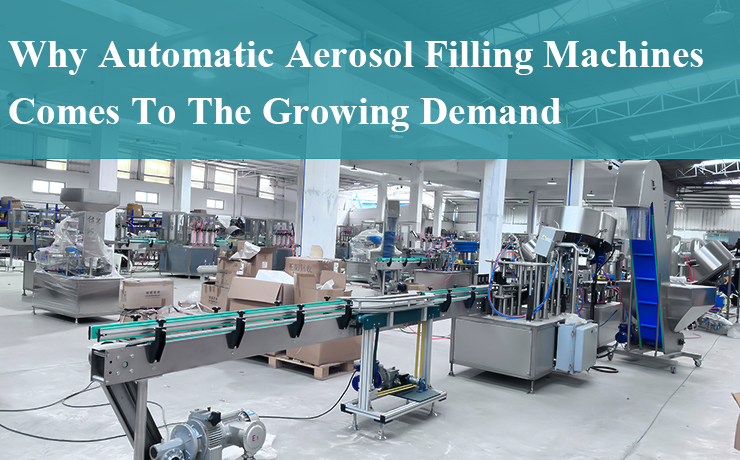
Transitioning from semi-automatic to fully automatic production is no longer just an optional upgrade. It is a mandatory operational shift. You need this transition to survive tightening profit margins and rising market demands. Today, aerosol applications expand far beyond traditional cosmetics. We see massive growth in culinary uses, like cooking sprays. We also see surging demand in household cleaning and high-growth medical sectors.
Upgrading to an automatic aerosol filling machine is no longer just about raw speed. It is about severe risk mitigation and material efficiency. You must achieve the agility required to handle fragmented, multi-product manufacturing runs. If you want to protect your bottom line, automation serves as the absolute baseline. We will explore why modern manufacturers are making this critical pivot. You will learn how precision, regulatory compliance, and quick changeovers dictate modern production success.
Key Takeaways
Market Trajectory: Global demand is accelerating (projected 4.6% CAGR), heavily driven by diversification in food, home care, and medical aerosol products.
The Cost of Inaccuracy: Just a 1% error margin in manual or outdated filling processes translates to severe cumulative financial losses.
Operational Agility: The industry "sweet spot" for capital efficiency is medium-capacity automation (100–200 Cans Per Minute) paired with quick-changeover capabilities.
Compliance as a Baseline: Modern automatic lines pre-solve stringent OSHA, NFPA, and VOC regulatory requirements through enclosed, explosion-proof architectures.
The Economic Drivers Forcing the Shift to Automation
Consumer habits are evolving rapidly across multiple industries. This evolution places intense strain on legacy manufacturing lines. Consider the culinary sector as a prime example. Cooking sprays are steadily replacing traditional bottled oils in modern kitchens. Consumers prefer the precise portion control aerosols provide. Meanwhile, medical aerosols are exploding in popularity. Industry data shows an 8% growth rate for medical inhalers alone. These niche surges require faster, more reliable production capabilities. Traditional semi-automatic lines simply cannot keep pace. They lack the speed and sanitary controls needed for these booming sectors.
Volume economics dictate the financial survival of manufacturing brands today. A powerful supply-and-demand feedback loop exists in aerosol production. Higher volume output directly lowers your per-unit manufacturing costs. When your factory produces 100,000 cans a day instead of 20,000, your fixed overhead spreads much thinner. You can then price your products more competitively. This aggressive pricing strategy helps you capture a significantly larger market share. Your automated equipment scales production efficiently without causing linear cost increases.
Labor reallocation is another massive driver pushing facilities toward automation. Finding reliable manual labor remains a persistent challenge globally. Automation allows you to reduce direct labor costs on the manufacturing line. You shift human resources away from repetitive, hazardous filling tasks. Instead, operators focus on high-value line monitoring and quality assurance. This strategic shift elevates workplace safety immediately. It removes workers from immediate proximity to pressurized propellants. It also maximizes human capital value. Your team solves quality problems instead of performing mundane mechanical tasks.
Precision and Yield: Solving the 1% Waste Problem
Overfilling causes severe, often unnoticed financial leaks in manufacturing facilities. Industry quality assurance benchmarks highlight this danger clearly. According to American Society for Quality (ASQ) standards, minor errors add up quickly. A seemingly minor 1% error margin in liquid or propellant filling destroys profits. It translates to massive cumulative financial losses over a fiscal year. Imagine giving away 2 milliliters of free product in every 200-milliliter can. Over a production run of one million units, you lose thousands of liters of expensive formulation. Every extra drop given away eats directly into your operational margin.
Modern automation solves this critical waste problem directly. High-end systems utilize servo-controlled volumetric and weight-based measurement technologies. These advanced mechanisms maintain a strict ±1% precision effortlessly. Servo motors provide instant, continuous feedback loops to the control system. They adjust fill volumes in fractions of a second. This precision works perfectly regardless of fluid viscosity. Whether you pump thin alcohol-based sanitizers or thick industrial greases, the machine delivers exact doses. It eliminates the guesswork inherent in older pneumatic cylinder designs.
Automation also removes human fatigue entirely from the equation. A tired worker inevitably makes measurement and handling errors. An automated system never tires. It runs the thousandth can exactly like the first. However, human operator impact remains highly relevant. Proper operator training is a key implementation reality. Your team must know how to maintain peak calibration accuracy. A highly precise machine still needs knowledgeable humans to oversee its digital parameters. Operators must understand the Human Machine Interface (HMI) thoroughly. They need to interpret sensor data to prevent calibration drift before it affects product yield.
Throughput vs. Flexibility: The "Quick Changeover" Imperative
Manufacturers constantly battle to balance high throughput against line flexibility. Currently, medium-capacity configurations completely dominate capital expenditure decisions. Machines running at 100 to 200 Cans Per Minute (CPM) hit the industry sweet spot. They perfectly balance high output with essential operational agility. Very high-speed lines (300+ CPM) require massive capital and lack flexibility. They only make sense if you run a single product all year. The 100–200 CPM tier gives you the volume you need while allowing frequent product changes.
We can observe the industry landscape clearly through a simple comparison chart of capacity tiers:
Capacity Tier | CPM Range | Primary Advantage | Ideal Manufacturing Profile |
Entry-Level / Semi-Auto | 15 - 50 | Low initial investment | Startups, lab testing, extremely small batches |
Medium-Capacity (Sweet Spot) | 100 - 200 | Perfect balance of speed and quick changeovers | Contract packagers, diverse product portfolios |
High-Speed Dedicated | 300+ | Maximum output volume | Single-product mass production (e.g., standard shaving cream) |
Downtime represents your true manufacturing bottleneck. Therefore, "quick changeovers" serve as a critical success criterion. Modern machines allow rapid switching between different chemical formulas. You can change can sizes and valve types rapidly. You accomplish this without spending hours on mechanical recalibration. Advanced machines feature recipe recall functions on their digital screens. Operators press a button to adjust rail widths and fill heights automatically. This agility keeps your production line profitable despite fragmented, smaller-batch orders.
Space optimization is another major factor for growing factories. Many facilities operate within severely limited square footage. Expanding the building is rarely a viable option. Monobloc systems offer the perfect spatial solution. A monobloc design consolidates filling, crimping, and gassing functions. It places them onto a single, highly efficient star-wheel footprint. You save premium floor space while maximizing production density. The cans travel mere inches between stations, reducing transfer errors and dropped units.
Regulatory Compliance and Safety Architecture
Aerosol manufacturing inherently deals with highly volatile propellants. Butane, propane, and dimethyl ether present serious facility risks. Therefore, compliance forms a strict operational baseline. Automated systems are meticulously engineered to handle these hazards safely. They meet strict OSHA and NFPA anti-spark and anti-combustion standards. Explosion-proof architectures protect your facility and your workers. Machines feature purged electrical cabinets. These cabinets maintain positive air pressure to keep combustible gases out. All sensors and motors carry Class I Division 1 hazardous location ratings.
Environmental controls are equally vital in modern manufacturing. Operations must contain Volatile Organic Compounds (VOCs) aggressively. Global environmental agencies penalize excessive emissions heavily. Modern closed-loop filling mitigates these severe environmental impacts. It protects your company from hefty regulatory fines. The automated system captures fugitive gases right at the gassing head. Local exhaust ventilation (LEV) systems pull vapors away before they escape into the factory atmosphere. This approach creates a healthier environment for your workforce and the surrounding community.
Flawless crimping valves are non-negotiable for product safety. The crimp seals the pressurized environment permanently. This step is especially crucial for pharmaceutical and food-grade items. These highly regulated sectors mandate strict tamper-evident requirements. Perfect crimping ensures absolutely zero leakage during transit. Even micro-leaks cause dangerous pressure drops over time. Modern automated crimping heads measure depth and diameter simultaneously. They reject any can failing to meet exact dimensional tolerances. This protects product integrity from your factory floor all the way to the consumer's hands.
Shortlisting Your Next Aerosol Can Filling Machine
Selecting the right equipment requires rigorous planning and deep operational self-awareness. You must define your exact success criteria first. Map out your product viscosities carefully. Document your specific can dimensions, including heights and neck diameters. Clarify your intended propellant types. You must decide if you need standard liquid propellants or Bag-on-Valve (BOV) systems. Have this critical data organized before you contact any vendors. Clear data ensures vendors quote the right equipment for your actual needs.
Follow these essential steps when evaluating an aerosol can filling machine:
Map exact product specifications: List every fluid viscosity and can size you plan to run.
Determine propellant technology: Decide between traditional direct gas injection or BOV setups.
Verify IoT scalability: Check if the machine offers real-time digital monitoring and remote diagnostics.
Confirm downstream integration: Ensure the machine communicates smoothly with your existing capping and labeling lines.
Finally, perform thorough vendor due diligence. Never evaluate a complex machine based on upfront price alone. The cheapest machine often causes the most expensive downtime. Key evaluation dimensions must include localized spare parts availability. You cannot wait weeks for a replacement seal to ship from overseas. You also need documented integration support from the manufacturer. Demand complete transparency during the Factory Acceptance Testing (FAT). You should run your most difficult product formulation during the FAT. Do not sign off until the machine proves its precision and speed guarantees under realistic conditions.
Conclusion
The growing market demand for automated aerosol lines is undeniable. Upgrading stems from a dual ability to protect profit margins and aggressively scale output. Servo-driven precision immediately stops costly product giveaway. Simultaneously, high throughput speeds and quick changeovers boost your overall facility capacity. You gain the agility to tackle diverse product categories, from culinary sprays to pharmaceutical inhalers, without sacrificing safety or compliance.
Operations leaders must take immediate, data-driven action. Audit your current line's unscheduled downtime meticulously. Measure your exact product-giveaway metrics closely. Use this hard data to build a verifiable return-on-investment case. Understand exactly how much money manual inefficiencies cost you daily. Compile these findings before requesting formal vendor proposals. A clear understanding of your current losses will guide you toward the perfect automated solution.
FAQ
Q: What is the average ROI timeline for an automatic aerosol filling machine?
A: Calculating labor savings, massive waste reduction, and increased capacity typically yields a 12- to 24-month payback period. This timeline heavily depends on your daily shift volume. Facilities running multiple shifts daily often see a return on investment closer to the 12-month mark due to accelerated labor cost reductions.
Q: Can one machine handle both traditional aerosols and Bag-on-Valve (BOV) systems?
A: While some high-end modular systems adapt to both, experts often recommend dedicated BOV machines. BOV systems require specialized under-the-cup gassing and crimping mechanics. Dedicated equipment ensures better precision for specialized water-based applications, gels, and food products where propellant must never touch the formula.
Q: What are the most common maintenance risks with automated filling lines?
A: Unscheduled downtime often stems from neglected preventative maintenance. You must regularly inspect and replace high-wear items. Pay close attention to elastomer seals, piston rings, and the mechanical collets inside crimping heads. Proactive replacement prevents precision drift and stops dangerous micro-leaks from occurring during production runs.


